





A drone hit a high-rise apartment building a few kilometers from the Kremlin, Moscow's mayor said, while Ukrainian authorities said a Russian missile attack killed six people and wounded others in the eastern Kharkiv region.
The strikes came a day after Kyiv announced it had hit a key Baltic Sea oil export hub and two vessels that Ukrainian President Volodymyr Zelenskyy said were part of Russia's "shadow fleet" of sanctions-evading oil tankers.
Nobody was hurt in the drone strike on the upscale Moscow tower early on May 4, Mayor Sergei Sobyanin said. Images showed what appeared to be one or two gutted apartments on a fairly high floor, and debris on the ground outside.
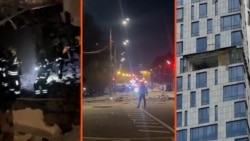


There was no immediate official comment from Ukraine on the hit on the building about 6 kilometers from the Kremlin.
It was the closest a strike has come to the seat of Russian power since a drone set the roof of a building inside the Kremlin on fire exactly three years ago in what Moscow said was a Ukrainian attack.
Moscow is heavily protected by air-defense facilities. Sobyanin said three other drones that targeted the capital were downed.
The incident occurred five days before Russian President Vladimir Putin is to host the annual Victory Day military parade, commemorating Germany's defeat in World War II, on Red Square. His administration has scaled down the ceremonies this year, citing Ukrainian attacks, and no heavy weapons are slated to be on display.
Putin announced a two-day cease-fire to coincide with the Victory Day celebrations. Unusually, the announcement was issued by the Defense Ministry, which also threatened Ukraine with a "massive, retaliatory strike... on the center of Kyiv" if Ukraine disrupted the Red Square events.
Not long after, Zelenskyy announced a cease-fire that would begin at midnight on May 5, days before the Russian events.
He also mocked the Russian statement.
"It is time for Russian leaders to take real steps to end their war; since the Russian Defense Ministry believes that it can't hold a parade in Moscow without Ukraine's consent," he said in a post to Telegram.

The more modest parade plans mean Russian authorities "fear that drones may fly over Red Square," Zelenskyy said at a May 4 summit in Yerevan of the European Political Community, a loose grouping of all European states apart from Russia, Belarus, and the Vatican. "This says a lot. It shows that they are not strong right now."
The drone strike came on the same day that several media outlets cited a leaked document from an unidentified European intelligence service as saying that security for Putin has been ramped up in recent months amid growing concerns in the Kremlin of a potential coup or assassination plot, particularly one involving drones.
The media outlets, including CNN, the Financial Times, and iStories, cited a report they said was provided on condition of anonymity by a person close to the intelligence service that produced it.
RFE/RL could not immediately corroborate the reports and there was no immediate comment from the Kremlin.

Most of Ukraine's drone attacks have targeted energy infrastructure and in some cases military sites. On May 3, Zelenskyy said Kyiv's strikes had caused substantial damage at the Baltic Sea port of Primorsk and also hit an oil tanker, a small Russian missile ship, and a patrol boat in the Baltic Sea.
The governor of the Leningrad region, where Primorsk is located, said a fire was quickly extinguished and there was no oil spill.
Zelenskyy said earlier in the day that Ukrainian forces struck two shadow-fleet tankers near the entrance to the Russian Black Sea port of Novorossiisk.
Russia, for its part, frequently targets Ukrainian energy infrastructure, though its attacks on cities and towns across the country have also killed thousands of civilians.
Moscow's forces stuck five facilities of Ukraine's state energy company, Naftogaz, over the previous 24 hours, CEO Serhiy Koretskiy said on social media on May 4. He said the company had to halt production at damages sites in the Kharkiv and neighboring Sumy regions.
In eastern Ukraine, a Russian missile attack killed seven people and wounded more than 31 others in the Kharkiv region town of Merefa on May 4, regional governor Oleh Synyehubov said on Telegram. In the south, at least one person was killed by Russian shelling in the Kherson region.
Ukraine's infrastructure minister, Oleksiy Kuleba, said Russia used more than 800 drones to attack port infrastructure from January to April, up from 75 in the same period in 2025. The Black Sea port of Odesa has been hit particularly hard.
Russia launched its full-scale invasion of Ukraine in February 2022, eight years after seizing the Crimean Peninsula and fomenting war in the eastern area known as the Donbas, and now occupies nearly one-fifth of Ukraine.
But Moscow's forces have made only minor gains over the past year or more, while suffering heavy casualties.
Several rounds of talks in recent months left Kyiv and Moscow deeply at odds on key issues including territory and security, and a US-led peace effort has stalled amid the US-Israeli conflict with Iran, with the most recent face-to-face meeting ending without a breakthrough in February.

Writing on Telegram ahead of the Yerevan summit, Zelenskyy said his goals would be to move closer to a “dignified” end to the war with Russia, to push forward the $106 billion support package for Ukraine, and “strengthening Ukrainian air defense and energy support for Ukraine and cooperation with partners in the field of energy.”
In a speech to the summit, Zelenskyy said "one common European voice" needs to be present at any peace negotiations.
"We need to find a workable diplomatic format and Europe must be at the table in any talks," he said.
After a meeting with European Commission President Ursula von der Leyen, Zelenskyy wrote on X that they discussed "the timeline for the first tranche [of the $106 billion support package], which will be directed toward joint drone production," and also "agreed to move forward actively on a Drone Deal with the European Union."