




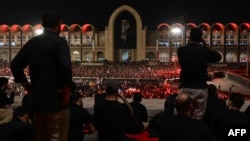
Iranian Supreme Leader Mojtaba Khamenei remained absent as funeral prayers for his father and predecessor, Ayatollah Ali Khamenei, were held early on July 5, more than four months after he was killed during US-Israeli strikes at the outset of the war in the Middle East.
State media said the funeral prayers would be held in three stages: first for Ali Khamenei, followed by prayers for family members also killed in the same US-Israeli strike, including his daughter, his daughter-in-law -- Mojtaba Khamenei's wife, Zahra Haddad Adel -- and his 14-month-old granddaughter.
Mojtaba Khamenei, who has been widely described by Iranian media as an ayatollah and was named supreme leader shortly after his father's death, was absent from the ceremony despite the tradition that each successor leads funeral prayers for his predecessor -- a role analysts see as reinforcing the legitimacy of the succession.
He has not been seen in public since he was reportedly injured in the same attack that killed his father on February 28, and no known audio or video recordings of him have been released in the intervening months, raising questions about his health and his ability to carry out his duties as supreme leader.
The Iranian authorities are likely to justify his absence from his father's funeral on security grounds. However, the attendance of virtually all of the Islamic republic's senior officials suggested the authorities were confident enough in the security arrangements despite the possibility of an Israeli or US attack.
President Masud Pezeshkian and Parliament Speaker Mohammad Baqer Qalibaf were in attendance, as were commanders of the Islamic Revolutionary Guard Corps (IRGC), and senior officers of the IRGC's overseas Quds Force, which oversees Iran's foreign military and covert operations.
On July 3, US President Donald Trump said Washington had given Tehran "a week off" for the funeral proceedings before the resumption of indirect negotiations with Iran on implementing a framework peace agreement.
Ali Khamenei's three other sons -- Mostafa, Masud, and Meysam -- all of whom had remained out of public view since the outbreak of the war, were present beside their father's coffin on July 5.
Funeral and mourning ceremonies for Ali Khamenei are due to continue over six days in cities across Iran and Iraq, with his burial scheduled for July 9 in the late supreme leader’s hometown of Mashhad.

The first day of the funeral ceremonies in Tehran on July 4 was marked by tight security, a heavy deployment of government security forces, and the declaration of a nationwide public holiday on July 5.
Authorities are seeking to draw millions of people to the funeral processions over the coming days, providing free transport, food, and accommodation as they stage a vast public display of mourning.
On the sidelines of the funeral ceremonies, Qalibaf met Mohammad Darwish, head of Hamas's leadership council.
Iranian state media quoted him as saying Iran was "not at peace" with the United States and would not recognize Israel, while also describing implementation of the US-Iran framework agreement as "difficult but achievable."
Delegations from Hamas, Hezbollah, the Houthis, and other Iran-backed armed groups from across the Middle East also attended the funeral proceedings, according to Iranian state media.
Hamas is designated as a terrorist organization by the United States, while only its military wing is listed by the European Union.
Meanwhile, security concerns elsewhere in the region remained high. United Kingdom Maritime Trade Operations (UKMTO), a shipping security monitor, saying on July 5 that it had received a report that a cargo vessel was under attack by unknown armed assailants about 30 nautical miles southwest of Yemen's Red Sea port of Al Hudaydah.
The vessel triggered a distress alert, and authorities are investigating. UKMTO advised ships transiting the area to exercise caution and report any suspicious activity.
Separately, the Russian news agency Interfax said Russian President Vladimir Putin and Trump had discussed Iran during a phone call on July 5.
According to the Kremlin, Putin expressed hope that ongoing indirect US-Iran talks would help produce "mutually acceptable long-term solutions" to the conflict.
The White House has not yet released its own account of the call.

