





Kyrgyzstan is set to enter the ranks of the world’s spacefaring nations in early October when a "nanosatellite" made in the Central Asian country is launched into orbit aboard a SpaceX rocket.
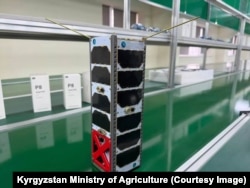
The bread-loaf-sized satellite will use an array of cameras and sensors to monitor crops, the impact of natural disasters, and “identify early signs of drought,” according to a September 24 statement about the spacecraft from the Kyrgyz Agriculture Ministry.

According to Ilya Cherny, the director of Kyrgyz Electronics, the technology company that oversaw the project, a team of about 10 Kyrgyz engineers worked on the 5 kilogram spacecraft over two and a half years. It has an estimated lifespan of 15 years and local reports estimated its build cost at around $130,000.
Kyrgyz officials describe the spacecraft as domestically developed and assembled, although Cherny noted that “most of the technologies” inside the nanosatellite are Russian, "because development from scratch takes 5-10 years."
The launch of the Kyrgyz satellite into orbit from California, scheduled to take place on October 1, marks the latest landmark in a space race that is heating up in Central Asia.

In August, Uzbekistan sent a Chinese-made satellite into orbit that included an “artificial intelligence module developed by specialists from the Uzbekcosmos Agency.” Additionally, Tashkent recently announced plans to produce its own satellite by 2028.
Kazakhstan has several domestically made satellites currently in orbit and in September the country announced plans to establish “an international constellation of nine satellites intended for Earth observation.” The constellation is set to include satellites provided by Mongolia, the Republic of the Congo, and Nigeria.
Nelly Bekus, an expert on Central Asia at the University of Exeter, told RFE/RL that for those states able to produce their own space infrastructure, the effort and expense is viewed as worthwhile from a national security standpoint.
"In recent years, as geopolitical tensions have increased worldwide, independent access to satellite data operated by national teams has also become increasingly important for state security," she said.
Bekus added that "spacefaring capabilities have long been associated with ideas of progressive nationhood, providing highly visible evidence of a nation’s technological prowess and its standing on the world stage."
Other Western analysts have pointed to the impulse among authoritarian governments to maintain a “kill switch” for communications during civil unrest.
Astana switched off Kazakhstan’s Internet for several days amid mass protests in the country in early 2022 and Uzbekistan has stated that its domestically made satellite planned for 2028 will ensure what it calls “a sovereign and objective source of information” in the country.
When Kazakhstan was involved in discussions to introduce Starlink for its rural populations, negotiations with Elon Musk’s SpaceX reached an impasse over a Kazakh requirement that ground stations -- communications dishes that feed signals to passing satellites -- be built inside the country, allowing Astana to maintain control.

