




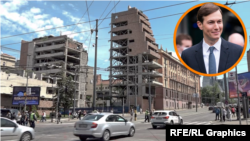
An investment company founded by Jared Kushner, the son-in-law of US President Donald Trump, has withdrawn from a planned $500 million hotel construction project in Belgrade amid a swirling controversy over the site, which was destroyed during the NATO bombing in 1999.
A spokesman representing Kushner's Affinity Partners said in a statement obtained by RFE/RL on December 16 that the plan to build a luxury complex where the bombed-out General Staff buildings stand had been scrapped.
The news of the withdrawal, first reported by the Wall Street Journal, came hours after the Serbia's Prosecutor's Office for Organized Crime filed an indictment against Culture Minister Nikola Selakovic for allegedly illegally removing the buildings' cultural heritage status.

"Our vision for the Belgrade project was to offer an elegant, uplifting design that honored Serbia’s progress. We are proud of the architecture our team created," the statement said.
"Because meaningful projects should unite rather than divide, and out of respect for the people of Serbia and the City of Belgrade, we are withdrawing our application and stepping aside at this time.”
Vucic announced that he would "personally file criminal charges" against "all those who participated in the witch hunt and the destruction of the investment," accusing them of "economic sabotage of Serbia."
"We will now be left with a destroyed building, and it is only a matter of time before bricks and other parts start falling off it, because no one will ever touch it again," Serbian President Aleksandar Vucic told journalists.
He also rejected allegations of corruption related to the project.
"There was never any corruption, nor was that ever the intention," he said.
The project had long been opposed by anti-government protesters in Serbia, opposition politicians, and the Association of Architects.
"The efforts of the Vucic government to get the property, the General Staff and Ministry of Defense building, to get it off the registry of culturally protected properties, monuments, had blown up in scandal. So, none of this is surprising," Edward P. Joseph, a lecturer and senior fellow at Johns Hopkins University in Maryland, told RFE/RL.
Joseph added that he raised the issue during a House Foreign Affairs Europe Subcommittee on December 2.
Cultural Heritage Site
Kushner, who is married to Trump's elder daughter, Ivanka, and served as a White House adviser during Trump's first term in office, last year announced the $500 million Trump Tower complex in central Belgrade.
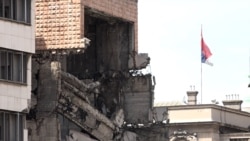
The development, designed by architect Nikola Dobrovic, centered on a pair of jagged unoccupied modernist brick structures in the center of Belgrade, the former General Staff headquarters for the Yugoslav Army.

The site was bombed by NATO jets in the spring of 1999 as part of a campaign to stop Serbian forces from attacking parts of Kosovo, which was still part of the country.
Despite being bombed out, the buildings retained their protected status due to what activists said was their architectural significance.
In the contract, Serbia was obliged to remove the cultural heritage designation from the General Staff complex "in a manner that is satisfactory" for Kushner's company, to complete the demolition of the buildings, also "in a manner that is satisfactory" for Affinity Partners. The land at the site was to be leased for free for 99 years.
In May, prosecutors announced that the cultural official in charge of the site's historic designation had forged a signature on a key document and had been arrested.
Goran Vasic, acting director of the Republic Institute for the Protection of Cultural Monuments, admitted he had fabricated an expert's opinion.
At the time, Affinity Partners denied any involvement in document falsification. It has also committed to building a memorial complex within the site dedicated to all victims of the NATO bombing.
On December 15, the public prosecutor filed its indictment of Vesic, Selakovic, and another Culture Ministry official for "illegalities when removing a status of cultural heritage site from the army headquarters buildings."