





WASHINGTON -- Fresh US strikes on Iran, Tehran's renewed attacks on American bases in the Persian Gulf, and President Donald Trump's announcement that Washington would reinstate a naval blockade on Iranian shipping have pushed the conflict into a new and uncertain phase.
But despite the intensifying military exchanges, Jonathan Schroden, chief research officer at the Center for Naval Analyses (CNA) and a leading US expert on irregular warfare, says that the current violence resembles the turbulent path many wars take before reaching a negotiated settlement.
RFE/RL: The US has launched fresh strikes inside Iran, while Tehran has retaliated against American bases across the Gulf. From a military perspective, where does this conflict stand today? Are we still witnessing controlled escalation, or is it entering a more dangerous phase?
Jonathan Schroden: What we're seeing now is fairly emblematic of how wars that end via a negotiated settlement of some kind actually play out. The US and Iran have a memorandum of understanding that outlines some terms that they've agreed to and lays out a path to continue talking effectively, and they've been doing that for the month or so since they signed that MOU.
But if you look at the history of negotiations to end wars that involve cease-fires especially, you oftentimes -- I think more often than not -- see breakdowns in those cease-fires and in the negotiations multiple times.

In some cases, over many months, if not years, the negotiations will move forward. There will be a breakthrough, talks will occur, the talks will break down, hostilities will start again.
You get this ebb and flow of progress in the negotiations, breakdowns followed by violence. The violence eventually reaches the point where the two sides want it to stop again. They reinvoke the cease-fire, they start talking.
These types of cycles are fairly common, and I think that's what we're seeing now.
I would further say that I think we're likely to see this cycle continue in large part because the set of issues that the US and Iran are dealing with are so complicated and are going to be so difficult to resolve.
RFE/RL: The Strait of Hormuz is once again at the center of the crisis, with commercial shipping slowing dramatically. What is the military significance of what's unfolding there?
Schroden: I think there are two components. One is the short-term aspect. The slowing of shipping through the strait to a trickle once again will continue to exacerbate the economic conditions being felt by consumers all around the world.
"You're seeing Iran continue its attacks on shipping and its military operations. It increasingly gains leverage the longer this conflict continues because, in some ways, it's like an insurgency. Insurgents win by not losing. That's Iran's strategy here as well..."
Whether that's increasing food prices, increasing agricultural difficulties due to the lack of fertilizer coming through the strait, increasing fuel prices, etc., all of that is going to continue to ratchet up based on the flow of traffic through the strait.
The longer-term picture is that the situation, as it's evolving, is starting to call into question the broader economic and security principle of freedom of navigation in international waters, which has been a stalwart of the international system and international order since the end of World War II, at least.
The fact that you now have Iran claiming control over the strait, and just today [July 13] President Trump said [in effect that] the US is going to be the guarantor of transit through the strait, but in so doing is going to charge a 20 percent fee for anything going through there [a proposal Trump later withdrew. -- Ed.].
In both cases, if those situations were to persist or come about, they would represent a violation of that long-held norm of free and fair passage through international waterways, including chokepoints like the Strait of Hormuz.
RFE/RL: President Trump says the US will become the "guardian" of the Strait of Hormuz while reinstating the blockade of Iranian ports. Operationally, what would it take for the US Navy to enforce that mission?
Schroden: Well, there are two components there. There's the blockade, which the navy has been imposing for at least several months now. The US has the naval assets in place, as I understand it, to continue executing that blockade in accordance with President Trump's direction. So, there's that component, which I think the US Navy is well positioned to provide.
The harder part is serving as the guarantor of passage through the strait because that is a lot more difficult. It's a narrow passageway. The threat profile extends from undersea, largely in the form of sea mines of various types, and nobody really knows how many of those Iran has put in the water, although I've seen estimates as high as 80 these days, which is much higher than prior estimates.
So, you have this undersea threat. You have a surface threat from the small boats and other attack craft that Iran has. Then, of course, you have an air threat from missiles and drones that Iran has shown itself to be very proficient at using and prolific in terms of the numbers that it possesses.
The US Navy can do it. It has guided missile destroyers capable of providing defense against that full range of threats for themselves and for a small number of ships convoying with them. But doing that repeatedly becomes increasingly dangerous over time.
Every time you escort ships through the strait using navy assets, there's a non-zero chance that either the escorted ships or a US Navy ship could get hit. The more you do it, the probability compounds over time, increasing the likelihood that something gets hit and potentially sunk. So, the risk accruing to the US Navy would continue to compound over time if that's the approach they take.
RFE/RL: The blockade is expected to apply to all vessels regardless of flag, with humanitarian shipments exempt following inspections. How difficult is it to distinguish legitimate commercial traffic from sanctions evasion or military activity in real time?
Schroden: Well, it's certainly not easy. The US Navy does not have the quantity of assets needed to board and physically inspect every ship it encounters while enforcing the blockade.
They're going to rely on a combination of intelligence from various sources to identify ships that might be of interest, as well as analysis of other factors. Where was the ship previously? What type of cargo does it traditionally handle? Who is it registered to? All of those factors would go into the various analyses the US military conducts to help narrow down the set of ships that really warrant attention.
That's how they would approach it. Enforcing a blockade is always a resource-intensive operation, so the navy will do anything it can to reduce the amount of resources it has to dedicate to that mission.
RFE/RL: US officials say neutral transit through the strait will still be permitted, while Iran insists the waterway is effectively "our territory." How does that complicate the operating environment for naval forces and commercial shipping?
Schroden: I think the calculation that shipping companies have to make is a very difficult one.
Prior to this recent escalation, they really had three choices. They could pay a fee to Iran and transit the route Iran had established through its territorial waters. They could [instead transit] through Oman's territorial waters using a route established by the US Navy. Or they could sit tight and hope for a better situation to emerge.
In no case did it seem safe to use the traditional shipping channels through the strait because those are widely assumed to be mined at this point.

With Iran now saying the strait is closed, that pathway through Iranian territorial waters appears to no longer be available. That reduces the choices to two: either wait or attempt to transit the Omani route that the US says remains open. But if you do that, you run the risk of being attacked by an Iranian missile or drone.
That's a difficult calculation for shippers. They're balancing risk against insurance costs, and I suspect that, at least in the short term, many more of them will decide to wait and see what happens.
RFE/RL: We've seen repeated crises in the strait over the years, but today's battlefield also includes drones, unmanned maritime systems, and precision missiles. Has the military balance fundamentally changed?
Schroden: I think, on paper, the major difference would be that the Iranian Navy -- its conventional navy -- no longer exists. The US largely destroyed the vast majority of Iran's conventional naval ships.

But that was never a major part of Iran's territorial defense strategy anyway. Iran primarily fights through asymmetric means: sea mines, small attack craft, drones, and missiles. It still has thousands of those capabilities remaining, even after the punishing military campaign the US conducted during the first 30 days of this war.
So, the capabilities Iran actually needs to implement its territorial defense strategy still exist in vast quantities. In that regard, I would say no -- the practical military balance isn't dramatically different from when the war began.
That's why you're seeing Iran continue its attacks on shipping and its military operations. It increasingly gains leverage the longer this conflict continues because, in some ways, it's like an insurgency. Insurgents win by not losing. That's Iran's strategy here as well: play your hand in a way that allows you to win simply by not losing.
RFE/RL: The Pentagon says the US used one-way attack sea drones in combat for the first time during its latest strikes. What does that tell us about the future of maritime warfare? And how much could strikes on Iranian naval infrastructure affect Tehran's ability to threaten shipping?
Schroden: I think there are two questions there.
On the second one -- how much would it affect Iran's capabilities? I haven't seen detailed information on the extent of the damage caused by those drone attacks. But from the few news articles I've read today, it doesn't appear to be particularly extensive or strategically significant.
On your first question -- what does this say about the future of maritime warfare?
I think it suggests that we're going to see much more unmanned activity across all domains. To date, we've primarily seen this in the air.
Obviously, the Russia-Ukraine conflict is dominated by airborne drones at this point. But the Ukrainians have also used unmanned surface and undersea vessels, especially in the Black Sea, to sink a number of Russian ships. Ukraine doesn't even have a navy, so the ability to do that without one is one of the more impressive aspects of that conflict. I think you're going to see more of that going forward, with countries that lack large, powerful navies using unmanned vessels to compensate for that lack of conventional power.
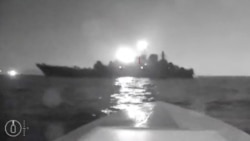
As for this particular US development, I don't know that it fundamentally changes how the US will fight in the immediate term. If you look at the cost of those three Corsair drones, each one costs more than a million dollars, and the targets they struck were largely stationary. You could ask whether it would have been better simply to hit those targets with missiles. The answer is probably yes.
But the US is using this war in some ways as a laboratory to test new technologies and see what it can learn from employing them. I suspect the value of these strikes lies more in what the US military can learn than in the actual damage inflicted on Iranian forces.

