




US President Donald Trump said Washington had begun “major combat operations” against Iran, putting the Middle East on edge as air raid sirens wailed across the region amid retaliatory strikes by Tehran.
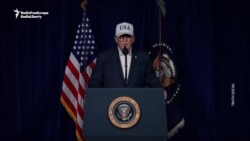
In a video statement posted on social media, Trump said on February 28 his objective in ordering the bombing of Iran -- which was done in concert with Israeli forces -- was “to defend the American people by eliminating imminent threats from the Iranian regime.”
"I do not make this statement lightly. The Iranian regime seeks to kill," Trump said in the video announcing the operation, named "Epic Fury" by the Pentagon.
"The lives of courageous American heroes may be lost and we may have casualties that often happens in war, but we're doing this, not for now. We're doing this for the future, and it is a noble mission."

Iran's Islamic Revolutionary Guards Corps (IRGC) responded to the US and Israeli strikes by launching several waves of drones and ballistic missiles against Israel. The Israel Defense Forces (IDF) said interception operations were underway and later reported further waves of missiles were headed toward Israel.
Iran also fired missiles at targets in Abu Dhabi, Dubai, and Bahrain. State media in the United Arab Emirates said one person had been killed in Abu Dhabi, but gave no details.
Iranian media reported explosions in several cities, including Tehran, Tabriz, Isfahan, Qom, Lorestan, and Chabahar.
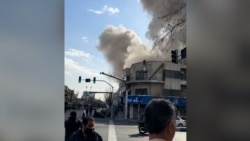
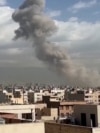
Video and photo images showed at least one large plume of smoke billowing over the capital.
Trump accused Tehran of attempting to rebuild its nuclear program after the United States bombed key facilities during a 12-day war between Iran and Israel last June. He said the United States also aimed to destroy Iran’s missile capabilities and “annihilate” its navy.
“The hour of your freedom is at hand,” Trump added, in an apparent message to the Iranian public.
Trump had previously vowed that “help is on the way” during the deadly January protests against Iran’s clerical establishment, in which thousands were reported killed. Tehran suppressed the unrest and accused the United States and Israel of orchestrating it.
White House Press Secretary Karoline Leavitt said in a post on X that Trump continues to "closely monitor" the situation along with his national security team and had spoken during the day to Israeli Prime Minister Benjamin Netanyahu by phone.
The strikes mark a dramatic escalation in Middle East tensions and all but quash hopes for a diplomatic resolution between Tehran and Washington over Iran’s nuclear program.
US and Iranian officials held a fresh round of Oman-mediated nuclear talks in Geneva on February 26 in what was seen as a last-ditch attempt to avoid a major military conflict between the foes.
Omani Foreign Minister Badr al-Busaidi, who has a history of mediating talks between two, said he saw "significant progress" and announced that technical level discussions will take place next week in Vienna.
He said he was "dismayed" by the strikes against Iran and that they "undermined" the peace process.
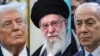
The United Nations Security Council is expected to hold an emergency meeting following the attacks. The UN said the session, scheduled to begin at 4 p.m. New York time, will address the “situation in the Middle East.”
"If we consider the experience of several years of negotiations, including the most recent round, it has shown that the Islamic republic will not retreat from its positions. This stance, in practice, causes other countries to feel threatened. Specifically, the Islamic republic’s missile program can pose significant risks," Leyla Morovati, a political analyst with expertise in Iranian domestic and foreign affairs, told RFE/RL's Radio Farda.
"Ultimately, some of these nations may feel compelled to align with these attacks -- even if not directly -- to see the Islamic republic severely weakened and its missile program dismantled or restricted. In other words, they will be moving in alignment with US and Israeli interests.”
Explosions were first reported in central Tehran, with images and videos circulating on social media showing thick plumes of smoke rising above the capital.
The Fars news agency, affiliated with the IRGC, said “several missiles” struck Daneshgah (University) and Jomhuri (Republic) streets. Iran’s state broadcaster, IRINN, confirmed what it described as joint “US-Israeli aggression in Tehran,” airing social media footage of smoke billowing from downtown areas.
Iranian Defense Minister Amir Nasirzadeh and IRGC commander Mohammed Pakpur are thought to have died in Israeli attacks, two sources familiar with Israel's military operations and one regional source said, according to Reuters.
Sirens sounded across Israel following the strike, and the IDF instructed residents to remain near protected areas, describing the alert as a precaution against possible retaliatory missile fire.
Trump warned that some Americans "may be lost" as a result of the operation, though senior US officials told reporters that so far there have been no reported US casualties from Iran’s retaliatory strikes against US military facilities in Bahrain, Kuwait, Jordan, UAE, and Qatar.
He also urged Iranians to rise up against the Islamic republic's leadership once the military action has concluded.
"When we are finished, take over your government. It will be yours to take. This will be probably your only chance for generations," Trump said.
Jennifer Gavito, former deputy assistant secretary of state for Iran, Iraq, and Public Diplomacy, told RFE/RL that Iran’s initial response to what seems to be an explicit call for regime change from the US and Israel "demonstrates that the regime believes this is an existential crisis and that it has nothing to lose."
"Given that, its reactions we are already seeing will be less predictable, more escalatory, and more likely to spark region-wide instability,” she said.

