




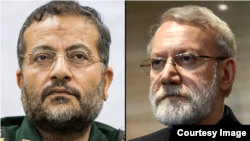
Iranian authorities have confirmed that the country's powerful security chief, Ali Larijani, has been killed, the highest-profile official to die since Supreme Leader Ayatollah Ali Khamenei was killed on the first day of US and Israeli air strikes on February 28.
Ali Larijani was killed along with his son Morteza, his deputy Alireza Bayat, and several bodyguards, the Secretariat of Iran's Supreme National Security Council said in a statement late on March 17. Larijani was secretary of the Supreme National Security Council.
The council's statement came about 12 hours after Israeli Defense Minister Israel Katz said Larijani was killed in a wave of air strikes on Tehran that also took the lives of other senior Iranian figures.
Death Of Gholamreza Soleimani
Separately, the Islamic Revolutionary Guards Corps (IRGC) confirmed the death of Gholamreza Soleimani, commander of Iran's paramilitary Basij force, giving few details. The Israel Defense Forces (IDF) had said Soleimani and Larijani were killed in the same series of strikes on March 16.
Katz said the two leaders "have joined Khamenei, the head of the annihilation program, along with all those eliminated from the axis of evil in the depths of hell," while Israeli Prime Minister Benjamin Netanyahu's office released a photo of the premier on the phone with the caption: "Prime Minister Benjamin Netanyahu orders the elimination of senior figures in the Iranian regime."
The US-Israeli offensive on Iran, now in its third week, has shown no signs of letting up, with air raid sirens heard in several locations around the Middle East on March 17.
US President Donald Trump said the conflict has "wiped out their [Iran's] military in every aspect" and reiterated during a press conference in Washington that the United States will leave the war "pretty much the very near future."
The Israeli military said it was targeting "Iranian regime infrastructure" in its latest wave of strikes across Tehran, as well as at sites it said were related to the Iran-backed Hezbollah group, which the United States has designated as a terrorist organization.
Baghdad Attack
Meanwhile, Iran has continued to fire missiles and drones at targets around the Middle East, including Israel. The key Strait of Hormuz -- which accounts for about one-fifth of the world's oil transport -- remains largely closed off due to attacks on vessels.
An Iranian drone and rocket attack targeted the US Embassy in Baghdad, according to security officials, one of whom told AFP that "at least one drone" crashed inside the embassy compound.
A new Iranian drone strike also hit the Fujairah oil complex on the United Arab Emirate's east coast, causing a fire but no injuries, local authorities said on March 17. Explosions were reported in Doha, while Qatar said it had intercepted a missile attack.
Trump had called on nations around the globe to help to reopen the vital waterway, but several countries have pushed back on the idea.
Later on March 17, he called that reluctance a "very foolish mistake" and that the United States didn't "need any help actually."
“This is a great test, because we don’t need them, but they should have been there,” Trump added.
Iran's targeting of crude oil and gas producing nations around the Gulf has pushed energy prices up sharply in many countries.
The price of several types of oil jumped around 5 percent again on March 17 over supply concerns.

