



WASHINGTON -- A renewed exchange of military strikes and threats between the United States and Iran has raised fresh fears of a wider Middle East war. But Jacob Stoil, a research professor of Middle East security studies at the US Army War College, argues the more important story may be what has not happened.
In an interview with RFE/RL, Stoil explains why the latest escalation still appears to be calibrated, how Iran is using missiles, drones, maritime pressure, and information warfare to gain leverage, and the indicators that could signal whether the crisis is moving toward a broader regional conflict or renewed negotiations.
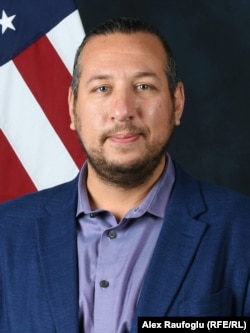
The views expressed in this interview are strictly those of Jacob Stoil and do not reflect the official policy or position of the US Army, the Department of Defense, or the US government.
RFE/RL: We've seen another round of heavy US strikes, Iranian retaliation, threats against American interests, and growing instability across the region. Yet in your recent research you argue that sometimes the biggest clue in a conflict is what doesn't happen. Looking at today's events, what is the "dog that hasn't barked" yet?
Jacob Stoil: The latest round of US strikes was in retaliation for an Iranian surprise attack against US facilities despite a renewed cease-fire. This is important because what we saw was an Iranian surprise attack followed by a limited US retaliation.
The US does not appear to have expanded the campaign toward bringing down the regime, and for its part Iran didn't initially strike every US allied and partner country in the region as it has in the past. Iran launched a limited strike against the US, and the US retaliated in a limited way.
Both could have used a lot more force, and both could have had a much more expansive target list. The other thing that, as I wrote in my article, is missing in the current round of escalation is any direct Iranian attacks on Israel.
RFE/RL: On the surface, this looks like rapid escalation. But from a military perspective, are Washington and Tehran still deliberately staying below the threshold of an all-out regional war? If so, what indicators tell you both sides are exercising restraint rather than preparing for a much broader conflict?
Stoil: Both Iran and the US have the capability to strike harder and to strike a wider variety of targets than they're hitting currently.
Iran has shown in the past that it can simultaneously hit targets in multiple countries around the region and reach as far as Israel, all while working with its proxies and allies such as the Houthis, Hezbollah, and even Hamas to escalate. It can greatly expand the scope of this conflict, and right now it isn't doing so. That is an indicator that, at this juncture, it is not interested in expanding the conflict.
In a similar manner, the US has a significant amount of military power that it has not yet brought to bear against Iran, and even in its latest retaliatory strikes it is not employing that full capability. That is another indicator that it is not currently expanding the conflict.
RFE/RL: Iran continues to respond through missiles, drones, and regional partners rather than direct conventional warfare. Does that reflect military weakness, or is it the strategy Tehran believes gives it the greatest leverage?
Stoil: For years, Iran has preferred the development of its missile force, its drone force, its irregular forces, and its proxy forces over its conventional military.
While its conventional military is large, its ground maneuver force and its air force are relatively weak, and they were further weakened by US and Israeli strikes earlier this year and last year. Its conventional navy was all but destroyed.

So Iran doesn't have the capability to effectively expand the war through ground maneuver in the way we've seen Russia do in Ukraine, or in a way that would really benefit it. Instead, it's playing to its strengths. Its strengths are in the information domain -- in creating false and misleading narratives and propaganda. Iran's strengths also lie in missiles, drones, and its ability to attack civilians and economic targets throughout the region.
RFE/RL: One of your latest studies focuses on Iran's strategy in the Strait of Hormuz. How do today's military operations fit into Tehran's broader effort to turn maritime pressure into political leverage at the negotiating table?
Stoil: Iran's strategy is to turn its ability to close the Strait of Hormuz and inflict economic pain on countries around the world into leverage at the negotiating table. The strikes Iran has carried out lately are an attempt to regularize the status quo.
Right now, Iran attacks its neighbors. Iran attacks other countries in the region. Iran has closed the Strait of Hormuz, and ships generally need Iranian tolerance if not permission to transit the strait.
Iran wants this to become the status quo. It continues to launch attacks against its neighbors, US forces, and shipping in the Strait of Hormuz to make its conduct in the conflict part of the normal day-to-day reality of the Middle East.


RFE/RL: Both sides claim military success while avoiding decisive escalation. Has information warfare become almost as important as battlefield operations themselves?
Stoil: For Iran, information warfare and the use of misinformation and disinformation are central to its strategy. Its goal is not to defeat US forces militarily. It knows it really can't do that. Its goal is to raise the political and economic costs of maintaining the conflict higher than the US is willing to pay.
That means attacking the will of the US and American partners while also undermining US public support for continuing the conflict.
Together with its closure of the Strait of Hormuz and its attacks against its neighbors using missiles and drones, the most effective tool in Iran's arsenal is information warfare.
RFE/RL: Finally, what should military analysts be watching over the coming days and weeks -- not the headlines but the indicators that would reveal whether the region is moving toward renewed negotiations or toward a broader regional conflict?
Stoil: It is important to understand that violence and negotiations are not opposite sides of the coin. Within a conflict, violence is also a form of language.
Iran and the US are using violence as part of a negotiation to establish tolerances. Iran is trying to make it acceptable that it can strike its neighbors with impunity, and every time the US retaliates, the US is sending a message about where the red line lies. Iran, in turn, is trying to push that red line.
So violence can itself be a language. When it comes to this conflict, negotiations are happening through violence, through information, and through other diverse channels.

