




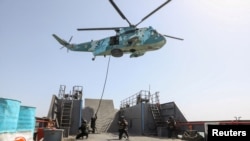
WASHINGTON -- With tensions high and the prospects for a deal to end the US-Israeli war with Iran uncertain, analysts say a "two-way street" of support from Russia and China is a crucial element of Tehran's ability to weather the effects of weeks of air attacks and keep its military machine running after severe losses.
At a forum hosted by the Washington Institute for Near East Policy on April 23, experts described deepening partnerships that have helped Iran replenish its military, improve targeting, and blunt Western operations during the conflict.
"A decisive factor in the future of this contest will be Iran's ability to resupply and reconstitute its own military capabilities," said Grant Rumley, the institute's senior fellow and director of its program on Great Power Competition and the Middle East.
"Tehran's backers are willing to provide some level of support to keep the regime in power," he added.
Rumley, a former Pentagon official who served in both the first Trump administration and the Biden administration as an adviser for Middle East policy, said the central question now is whether that external support will prove decisive as Iran seeks to rearm and reposition itself in preparation for what's next, whether it's peace or more warfare.
A 'Two-Way Street' With Moscow
While Iranian officials have long emphasized self-reliance, panelists said battlefield evidence points to a far more interconnected war effort, particularly with Russia.
Nicole Grajewski, an assistant professor at Sciences Po and a nonresident scholar at the Carnegie Endowment for International Peace, said the Russia-Iran relationship has evolved far beyond the simple purchase of hardware.
"The relationship is not only based on components.... It's also based on learning and sharing data between each other," said Grajewski, the author of a recent book on Russian-Iranian ties.

She noted that the "signatures" of Russian drone tactics, refined during the war in Ukraine, have surfaced in Iran's recent operations. "You see some of the signatures of Russian swarm elements...and Iran actually incorporating that in this recent war."
Beyond tactics, Grajewski highlighted the critical role of "offshore" intelligence, surveillance, and reconnaissance (ISR) support -- support from abroad.
She noted that Russia has reportedly provided Iran with satellite imagery and "damage assessments," enabling Tehran to constantly improve its strikes against US and regional targets.
China's 'Low-Cost' Strategic Play
If Moscow provides the tactical blueprint, Beijing appears to be providing the industrial and technological backbone.
Hasan Alhasan, a senior fellow for Middle East Policy at the International Institute for Strategic Studies (IISS), said Chinese assistance spans so-called dual-use components, such as rocket fuel ingredients, and sophisticated satellite data.
"There are multiple indications that China has been providing Iran with various forms of military support...that support may have had a tangible impact on Iranian military performance," Alhasan said.
He pointed to a Chinese company using AI to analyze satellite imagery of US assets at Prince Sultan Air Base in Riyadh just days before a "devastating" Iranian attack.
For Beijing, the conflict serves a dual purpose. "China does here see a low-cost opportunity to entangle the US militarily on the strategic level in Iran and then, tactically speaking, test some of its capabilities against the United States in a real conflict environment," Alhasan said.
Endurance and Geography
Matthew Tavares, a defense analyst and former Pentagon official with nearly two decades of experience in Russia strategy, said the revitalization of the Russian defense industrial base has directly benefited Iran.
"The Alabuga facility not only is producing equipment based on Iranian designs, but is improving on that equipment," Tavares said of a compound in Russia's Tatarstan region that includes a drone assembly plant, adding that he believes contractual arrangements likely allow for these systems to be sent back to Iran if the regime is attacked.
Tavares warned the conflict has shifted into a "factory versus factory" war and said Iran and its backers are producing inexpensive precision weapons systems that can "wear out" the "expensive, exquisite systems" favored by the United States and its Persian Gulf partners.
Despite the influx of external support, the experts cautioned that Tehran's own strategic posture remains the foundation of its survival.
Alhasan noted that Iran's ability to hold the Strait of Hormuz "hostage" and its high tolerance for "punishment" are indigenous strengths that external powers only augment.
"Iran's biggest assets during this war have been, on the one hand, its endurance...and then, on the other hand, its ability to leverage its systems and geography," Alhasan concluded.

