



Macron Calls For US-Iran Talks To Resume
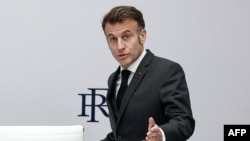
French President Emmanuel Macron says he spoke separately with his Iranian counterpart, Masud Pezeshkian, and US President Donald Trump on April 14 and called for the resumption of talks between Washington and Tehran and for a halt to any escalation of tensions.
In a post on X, Macron pointed out that the cease-fire between the parties must be fully respected by all parties and that it should include Lebanon.
"It is also very important that the Strait of Hormuz be reopened as soon as possible, without any restrictions or complications, unconditionally," he added. "In such circumstances, negotiations should be able to resume quickly and with the support of the main actors."
He continued: "France and Britain will hold a conference in Paris this Friday that will bring together, via videoconference, countries not involved in the war that are ready to contribute to a multilateral and purely defensive mission with the aim of restoring freedom of navigation in the strait."
Since the beginning of the US-Israeli strikes on Iran on February 28, the Islamic Revolutionary Guards Corps (IRGC) has effectively restricted passage through the Strait of Hormuz, with only a small number of tankers and ships belonging to "friendly countries" of Iran being able to pass through.
Disruptions in the supply chain of energy and other products such as helium, chemical fertilizers, and petrochemical products have caused a sharp increase in oil and gas prices, as well as a shortage of strategic goods in the world.
Russia's Lavrov Visits Beijing As China Steps Up Iran War Diplomacy
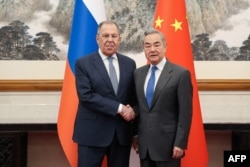
Russian Foreign Minister Sergei Lavrov arrived in Beijing as China steps up diplomatic efforts around the war in Iran amid a US blockade on vessels calling at Iranian ports that the Chinese Foreign Ministry has called "dangerous and irresponsible."
Lavrov is expected to hold talks with Chinese Foreign Minister Wang Yi during his April 14-15 visit, which will cover the wars in Iran and Ukraine, as well as Beijing and Moscow's deepening ties, according to Russia's Foreign Ministry.
"A thorough exchange of views is expected on a number of 'hot topics' and regional issues, including the Ukrainian crisis and the situation in the Middle East," the statement said, adding that Chinese-Russian cooperation at multilateral bodies like the Asia-Pacific Economic Cooperation, BRICS, the G20, the Shanghai Cooperation Organization (SCO), and the United Nations will also be discussed during the visit.
To read the full report, click here.
IEA Report Says Iran War Causing Worst Oil Shock Ever
The International Energy Agency says global oil demand will shrink more than at any time since the COVID-19 pandemic amid the "most severe supply shock in history" owing to the Iran war.
The IEA's annual monthly oil market report was released on April 14, the first full day of a US naval blockade of Iran that the agency said was the latest development in a "fast-evolving situation."
The blockade was launched after US-Iranian peace talks in Islamabad on April 11-12 failed to reach agreement, although a cease-fire that began on April 8 is still holding.
"It remains unclear whether the cease-fire will turn into a lasting peace and a return to regular shipping flows through the Strait of Hormuz. With oil-importing nations scrambling to source replacement barrels from an increasingly shrinking pool of supply, physical crude oil prices surged to record levels," the IEA said.
Israeli Strikes On Iran Oil Depots May Amount To War Crimes, Says Rights Group
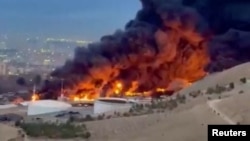
Human Rights Watch (HRW) says Israeli air strikes on oil depots around Tehran in March may have caused serious long-term harm to civilians and could constitute war crimes.
In a report published on April 13, the organization said attacks on infrastructure that is primarily civilian in nature and causes foreseeable harm "are violations of international humanitarian law and are likely war crimes."
The strikes took place on March 7 when Israel targeted four oil depots in the Tehran area. Iranian authorities reported the following day that "four sites used for storing and distribution of petroleum products and a petroleum products transport center…were attacked by hostile enemy aircraft."
On the same day, the Israel Defense Forces announced it had struck "several fuel storage complexes" in Tehran that belonged to the Islamic Revolutionary Guards Corps (IRGC).
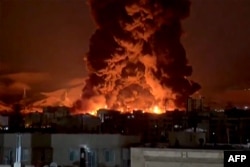
HRW said the attacks could have severe long-term consequences for those living in Iran. The strikes "may have devastating consequences on the environment and people's health for many years and likely amount to war crimes," wrote HRW researcher Bahar Saba.
"Israeli forces don't appear to have factored in the foreseeable long-term harm…and should be held accountable," she added.
The organization said it based its findings on interviews with eight people in Tehran and Karaj, consultations with nine environmental and health experts, and analysis of satellite imagery and verified videos.
HRW wrote to Israeli and Iranian authorities on March 26 requesting clarification. Iranian officials did not respond. Israeli officials replied on March 30, saying the strikes were "conducted in accordance with the principles of distinction, proportionality, and precautions."
They added that the targeted facilities were "to provide fuel directly to units in the regime's armed forces…including aviation, UAVs, [and] naval vessels."
HRW said it had confirmed that the oil depots were used for "civilian purposes" but noted it could not determine whether they were also used for military support.
An informed source told the organization that "the oil depots only contained gasoline and diesel…not used for aviation, UAVs, or naval vessels."
The rights group concluded that, given the foreseeable environmental and health damage, the strikes raise serious concerns under international humanitarian law and may amount to war crimes.
UN Secretary-General Says 'No Military Solution' To Iran War
United Nations Secretary-General Antonio Guterres called for continued diplomacy to resolve the conflict in the Middle East, stressing that a negotiated solution is the only viable path forward.
In a post on X on April 14, Guterres said "after weeks of destruction & distress, it is clear that there is no military solution to the current conflict in the Middle East," and urged all sides to pursue dialogue.
He also emphasized that "freedom of navigation must be respected," underscoring the importance of maintaining international law in key waterways such as the Strait of Hormuz.
His remarks come after recent talks between Iran and the United States ended without a breakthrough.
Length Of Uranium Enrichment Ban Reportedly A Major Stumbling Block In US-Iran Talks
The length of a ban on the enrichment of uranium was a key obstacle to reaching a deal in US-Iran peace talks last weekend in Islamabad, according to reports in the Wall Street Journal and the New York Times.
The outlets, citing US officials close to the negotiations, said Washington was seeking a 20-year moratorium on enrichment in exchange for relief from US sanctions on Tehran. The New York Times added that Iran's negotiating team offered a counter proposal of five years.
Neither US or Iranian officials have confirmed or commented on the reports.
Israeli Prime Minister Benjamin Netanyahu said on April 13 that Vice President JD Vance, who led the US delegation in Islamabad, had told him removing of all of Iran's uranium that has been enriched to a level of 60 percent is a "central issue" for Trump.
Netanyahu added that Trump also wants to ensure "that there is no further enrichment in the years ahead -- even decades ahead -- no enrichment within Iran."
Delays And Rising Costs: Central Asia Feels Fallout From Iran War
In Dubai, rows of cars bound for Kyrgyzstan are sitting idle. Aktilik Alipbay uulu, a Kyrgyz importer based in the city, isn’t sure when they'll move.
“We haven’t received clear information like ‘load now, it will arrive in 35–40 days,’” he says. “So, we are keeping the cars in garages. These are entrusted goods. If something happens at the port, it would mean losses for us.”
Previously, cars shipped by ferry across the Persian Gulf to Iranian ports then traveled overland to Bishkek. With the war in Iran, that supply chain has slowed significantly.
“The strait is not completely closed, cars are still moving, but they are being held in ports for 15–20 days or even up to a month. We are trying to get them out to Kyrgyzstan, but there are serious delays. They are stuck in Iranian ports,” says Alipbay uulu.
“People at the ports are afraid to release shipments because missiles are being fired across the Persian Gulf. That’s why the cargo is being held up. That’s why everything is being held up.”
To read the full report, click here.
We are now closing the live blog for the day. We'll be back tomorrow at 7:30 a.m. Central European time to cover the latest events across the Middle East.
Vance Says Ball In Tehran's Court After 'Progress' In Peace Talks In Islamabad
- By RFE/RL
US Vice President JD Vance says the ball is now in Iran's court after peace talks last weekend in Islamabad made "a lot of progress."
Speaking to Fox News in an interview on April 13, Vance said that during the peace talks, which lasted around 20 hours, "we actually made very clear what our red lines were."
"I really think the ball is in the Iranian court, because we put a lot on the table," Vance said.
He added that during the talks, it was made clear that US President Donald Trump had no flexibility with regard to Iran's enriched uranium, which Washington must have, and the verification mechanism that would ensure Tehran does not develop nuclear weapons in the future.
"It's one thing for the Iranians to say that they're not going to have a nuclear weapon. It's another thing for us to put in place the mechanism to ensure that's not going to happen," Vance said.
Toll Booths and Tankers: How the US Navy and Economic Sanctions Aim To Squeeze Tehran
WASHINGTON -- A US naval blockade on ships entering Iranian ports and coastal areas took effect on April 13 as Washington increasingly turns to "economic statecraft" to force Tehran to agree on a peace deal after weeks of air strikes.
RFE/RL spoke with Max Meizlish, a research fellow at the Foundation for Defense of Democracies (FDD) and a former official at the US Treasury’s Office of Foreign Assets Control (OFAC), on the intersection of naval blockades and financial warfare.
Meizlish argues that while kinetic air strikes grab headlines, the real battle is being fought against the Chinese financial lifelines and clandestine trade networks that keep the Iranian regime afloat.
To read the full interview, click here.