



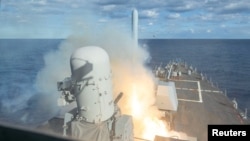
US President Donald Trump has given Tehran 48 hours to "fully open" the crucial Strait of Hormuz or the United States will "obliterate" Iran's power plants, a major escalation of tensions in a war that already threatens to spin out of control.
The deadline threat was posted on Trump's Truth Social platform on the evening of March 21, saying: "If Iran doesn't FULLY OPEN, WITHOUT THREAT, the Strait of Hormuz, within 48 HOURS from this exact point in time, the United States of America will hit and obliterate their various POWER PLANTS, STARTING WITH THE BIGGEST ONE FIRST!"
He did not specify which power plants would be targeted, and the warning came a day after Trump had said he was considering "winding down" military operations.
Even as he spoke, the Pentagon was sending thousands of additional ground forces to the region aboard US Navy ships to bolster military assets in the war with Iran, multiple media outlets reported. The Pentagon hasn't commented officially on the reported deployments.
In an almost immediate response to Trump's ultimatum, Iran's military command was quoted by state media as saying that if Iran's fuel and energy infrastructure is attacked, all energy infrastructure belonging to the United States in the region will be targeted. Iran also said desalination facilities will be struck.
Backing up that claim, Mohammad Baqer Qalibaf, the speaker of the Iranian parliament, warned on X that "Immediately after the targeting of power plants and infrastructure in our country, vital infrastructure and energy and oil infrastructure throughout the region will be considered legitimate targets and will be irreversibly destroyed."
Separately, Iran's Islamic Revolutionary Guard Corps (IRGC) threatened to completely close the Strait of Hormuz, adding that it would only be reopened once any facilities destroyed in US attacks had been rebuilt.
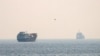
Although not physically blocked, Iran has made the waterway ungovernable through a combination of kinetic strikes, mines, electronic warfare, and market fear.
Blockage of the strait has restricted global supplies, sending oil prices surging worldwide and raising the cost of living for hundreds of millions of people.
Trump has demanded that countries that utilize the strait for transport of their energy resources take the lead in protecting shipping through the waterway by military escort or other means.
US European allies and Japan have expressed readiness for "appropriate" efforts to secure passage through the strait, but many have said such an action would only come after a cease-fire, angering Trump, who called them "cowards."
Tit-For-Tat Attacks Near Nuclear Sites
Meanwhile, Israel and Iran appeared to intensify risks of a major disaster, with each side striking close to nuclear facilities of the other combatant, raising the rhetoric level in Tel Aviv and Tehran and worrying the UN atomic watchdog.
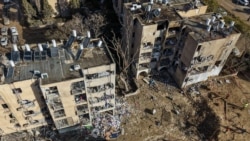
An Iranian missile on March 21 hit the two southern Israeli towns of Arad and Dimona, with a reported 175 people needing medical treatment.

Media also reported that blasts were heard and air raid sirens sounded in Jerusalem early on March 22 after the Israeli military warned of incoming missile fire from Iran.
Dimona is home to a nuclear facility, in what Tehran said was in retaliation for strikes on its Natanz uranium enrichment facility earlier in the day.
Israel has never publicly acknowledged that it has a nuclear weapon and the Dimona complex is officially described as a research facility. The site, just outside the main town, is widely believed to possess Israel’s nuclear arsenal, the only such holding in the Middle East.
After the earlier strike on Iran's Natanz site, the International Atomic Energy Agency (IAEA) reiterated its call for "military restraint to prevent a nuclear accident."
The IAEA then repeated the call for "maximum military restraint" following Iran's missile launch against Dimona.
"The IAEA is aware of reports of an incident in the city of Dimona, Israel, involving a missile impact and has not received any indication of damage to the nuclear research center Negev," the agency said on X.
"Information from regional states indicates that no abnormal radiation levels have been detected," it added.
The Israeli Army announced on March 22 that Iran has fired more than 400 ballistic missiles at Israel since the start of the war three weeks ago and that about 92 percent of which have been intercepted.
Meanwhile, Israel also said its forces had struck a facility within a Tehran university that it claimed was being used to develop components for nuclear weapons.
"The Malek-Ashtar University facility was utilized by the Iranian terror regime's military industries and ballistic missiles array to develop nuclear weapon components and weapons," the military said.
Hezbollah Attacks, Gulf States Targeted
In a parallel development, the Iran-backed Hezbollah militant group said it attacked Israeli soldiers in northern Israel's Misgav Am, where first responders said rocket fire from Lebanon killed one person.
The death is the first Israeli fatality from fire from Lebanon since fighting started with Hezbollah on March 2.
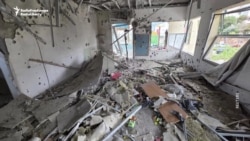
There were also reports of at least six overnight attacks targeting a US diplomatic and logistics center at Baghdad's International Airport while Saudi Arabia and the United Arab Emirates also detected Iranian missile and drone attacks.
'Battle For Our Future'
Israeli Prime Minister Benjamin Netanyahu vowed to continue striking Iran after what he called a "very difficult evening" following the attacks on Dimona and Arad.
"This is a very difficult evening in the battle for our future," Netanyahu said in a statement. "We are determined to continue striking our enemies on all fronts."
Israeli Defense Minister Israel Katz warned that Israel and the United States would begin intensifying their air strikes on Iran beginning on March 22.
"The intensity of the strikes to be carried out by the IDF and the US military against the Iranian terror regime and the infrastructure on which it relies will rise significantly," Katz said in a statement.

Iran's Longest Shot
The world continued to react to Iran's surprise launch of ballistic missiles toward the joint US-UK base on the island of Diego Garcia, some 4,000 kilometers from Iranian territory.
Israel said Iranian forces had for the first time fired long-range missiles, expanding the risk of attacks beyond the Middle East. Neither missile hit the site.
"These missiles are not intended to strike Israel. Their range reaches European capitals -- Berlin, Paris, and Rome are all within direct threat range," Israeli military chief Eyal Zamir said.
The British cabinet minister Steve Reed said on March 22 that one missile launched "fell short" while another missile was "intercepted." He also added that there was no assessment that backed claims that Iran was planning to strike European cities with ballistic missiles, or that it had the capacity to do so.