


France has announced that it now supports the designation of Iran’s Islamic Revolutionary Guards Corps (IRGC) as a terrorist organization, marking a major policy shift that could clear the way for European Union consensus on the issue.
French Foreign Minister Jean-Noel Barrot said on January 28 that “France will support the inclusion of the Islamic Revolutionary Guards Corps on the European list of terrorist organizations.” His announcement follows similar reversals by Spain and Italy, which had also hesitated to back the move but shifted their positions ahead of the January 28 meeting of EU ambassadors.
The United States, Canada, and Australia have already designated the IRGC as a terrorist organization. Within the EU, Germany and the Netherlands have repeatedly urged the bloc to follow suit, arguing that the group’s involvement in repression at home and destabilizing activities abroad warrants such a step.
The decision comes as the bloc's ambassadors agreed to impose new sanctions on several Iranian officials for their role in a deadly crackdown on nationwide protests that rocked the Islamic republic earlier this month. They also approved a separate tranche of sanctions targeting Iranian individuals and entities for aiding Russia’s war against Ukraine.
The measures, which include asset freezes and visa bans, were approved on January 28. The bloc’s foreign ministers are expected to rubber-stamp them on January 29.
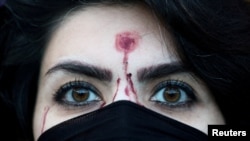
Protests erupted on December 28, 2025, over economic woes including currency collapse but morphed into anti-regime demonstrations that were met with lethal force.
The protest-related sanctions target Iran's Interior Minister Eskandar Momeni and 14 other senior officials.
Momeni, who oversees Iran's Law Enforcement Forces (LEF) and security units within the Islamic Revolutionary Guards Corps (IRGC), is held responsible for hundreds of protester deaths.
The interior minister, who also serves as deputy commander-in-chief, led forces that "suppressed street protests," resulting in thousands of casualties, according to the EU.
Death Sentence Threats
Prosecutor-General Mohammad Movahedi-Azad is targeted for designation after threatening demonstrators with death sentences on charges of "enmity against God" during the protests.
Regional IRGC commanders, including Heydar Olfati in Ilam Province and Ahmad Ali Feyzollahi of the IRGC Ground Forces' elite Saberin Brigade, are accused of ordering troops to fire on peaceful crowds.


The US-based Human Rights Activists News Agency (HRANA) says that as of January 28 it had verified 6,221 deaths, including 214 security forces, with more than 17,000 deaths still under investigation.
The EU measures also target six entities enabling repression, from the Iranian Audio-Visual Media Regulatory Authority (SATRA), which censors dissent, to tech firms Yaftar and Douran that develop VPN blockers and facial recognition tools.
The Working Group for Determining Instances of Criminal Content (WGDICC), a judicial body that filters and censors Internet access, is also being sanctioned.

Iranians have been cut off from the outside world since January 8, when authorities imposed a near-total nationwide Internet shutdown as the crackdown on protests intensified.
Access is slowly being reinstated, but experts fear authorities will eventually force Iranians onto a domestically designed "intranet" that operates independently from the global Internet.
Sanctions For Aiding Moscow
Separately, the ambassadors approved sanctions targeting four individuals and six entities linked to Iran's ballistic missile and drone programs that supply Moscow.
The entities include Sahara Thunder and the Khojir Missile Development and Production Complex.
The document describes Sahara Thunder as a Defense Ministry front company serving as an import-export cover to ship drones, components, and technology to Russia in exchange for payments.
The Khojir complex, meanwhile, produces Fath-360 close-range ballistic missiles allegedly delivered to Russia, where the EU says troops are being trained to operate them. Jointly managed by the IRGC and Defense Ministry, the facility manufactures solid-propellant missiles used against Ukrainian targets.