




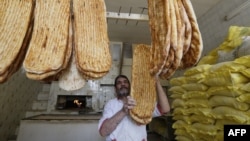
Iranian authorities have begun limiting how much subsidized bread households can buy in at least three provinces. Once a monthly quota runs out, buyers pay 5 1/5 times the price.
Officials have given conflicting accounts of what's going on, and the move has drawn criticism from economists and even from hard-line media.
The Interior Ministry's scheme, called "bread purchase management," was switched on through bakeries' card readers in Markazi, Khuzestan, and Zanjan provinces. There was no public announcement and neither bakers nor customers were briefed, Iranian media reported on November 18.
Under the plan, each person is allotted about 8 kilograms of subsidized flour a month at 23,000 rials -- less than 1 US cent -- per kilogram. Above that, bread is charged at the free-market rate of 126,500 rials, or about 5 cents. The sums look small in dollar terms only because Iran's currency has collapsed; the dollar trades at around 2.7 million rials on the open market, and the monthly minimum wage of about 166 million rials is worth roughly $61.
The media can't seem to agree on what to call it. Some insist it is "rationing," while others reject the label.
'A Sign Of Poverty'
Some of the sharpest criticism has come from within the establishment.
The hard-line daily Keyhan, whose chief editor is appointed by the supreme leader, accused President Masud Pezeshkian's government on November 16 of the "secret and suspicious implementation of bread rationing," which it said had caused people to rush to bakeries. The reformist daily Sharq also criticized the government's "quiet" implementation of the scheme.
The conservative Tabnak website argued that "consuming more bread is a sign of poverty, not abuse" in an apparent dig at officials who have complained about the rising demand for bread. It added that low-income families rely on bread when they can't afford other food.

Speaking on November 18, Pezeshkian defended tighter controls by pointing to large-scale abuse of cheap energy and staples. Among his examples were repeated fuel purchases at petrol stations in a single day, crypto miners running on subsidized power, and individuals who "bought up to 18 tons of subsidized bread a month."
Sweden-based Iranian economist Ahmad Alavi told RFE/RL's Radio Farda that the bread curbs follow a familiar pattern. Under what he described as a sea, land, and air blockade of Iran, oil and export revenues are shrinking and recession makes it impossible to raise taxes.
"First goods are rationed, then the ration is cut and the consumer is sent to the free market," Alavi said. "The resources that are freed up go to the establishment to finance its priorities." He listed those priorities as the war with the United States, regional proxies, and domestic security forces.


He said a flat per-capita quota ignores how different Iranian households are. It repeats the failures of Soviet-style central planning and produces what he called "inverse allocation," meaning people who don't need the subsidy get it and those who do lose out. He said the cash handouts that have been in effect since 2010 went the same way.
"Bread is a public good," Alavi said. "Everyone should be able to obtain it quickly and at a low price, and there should be no discrimination in it."
He said the state was targeting the end of the supply chain because it was the easiest point to control given how large Iran's informal economy is, referring to economic activities that take place outside of government regulation.
But Alavi warned the costs would show up later as lost social capital, deeper poverty, and malnutrition that the state would end up paying for in health care.
"It is efficient neither in execution nor in saving money," he said.