




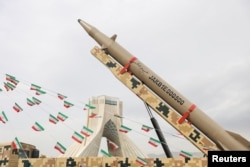
When images from the 47th anniversary of Iran's Islamic Revolution were published around the world on February 11, Hossein Amanat's heart sank. The imposing backdrop to the missiles and drones paraded at the Tehran event was the Azadi Tower, which the Iranian-born architect designed more than half a century ago.
"I feel so sorry," Amanat said of his most beloved work being coopted by the same government that once put him on a death list. "They are so unjust that they use anything to give themselves legitimacy."
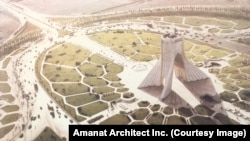
Amanat was 24 years old when he won a 1966 contest to design a monumental gateway to Tehran. Originally named the Shahyad (Shah's Memorial) Tower, the 45-meter landmark was to be completed in time for the grand celebrations planned by Shah Mohammad Reza Pahlavi to mark the 2,500th year of the Persian Empire.
Today the monument is widely regarded as the most iconic example of modern architecture in Iran, serving as visual shorthand for Tehran comparable to the Eiffel Tower in Paris. But Amanat says he had no sense of the structure's significance until he saw the finished project with his own eyes in 1971.
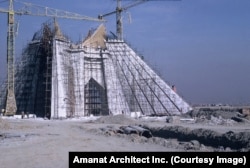
"I was working with a friend of mine in the basement [of the tower]," the 83-year-old recalled. "Somebody came and said: 'The scaffolds are off. Do you want to have a look?'"
Walking beneath the monument, Amanat told RFE/RL by phone, "I had goosebumps all over my body…. Usually I know what I'm designing, but going under that arch and looking up, it really overwhelmed me." The outcome, he said, had exceeded his own vision.
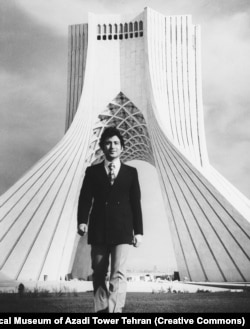
When the shah held a ceremony to open the monument in October 1971, its young architect stood and watched far from the assembled foreign dignitaries, which included the younger brother of Japan's Emperor Hirohito and Imelda Marcos, the first lady of the Philippines.
To Amanat's surprise, he was spotted by the Iranian ruler. "When he approached me he turned to all the kings that were there, especially [the Emperor of Ethiopia] Haile Selassie," Amanat recalled, "and he said, 'This young man has built this building,' and he was full of pride."
After Iran's Islamic Revolution in 1979, statues to the shah were torn down throughout the country and a massive demolition effort wiped out a mausoleum to his father. The Shahyad Tower seemed an obvious target for similar treatment, yet it survived and was renamed the Azadi (Freedom) Tower.
Amanat believes there are two reasons the tower was not demolished, despite some in the new regime wanting it gone.
"I think because of the attention to this building, they couldn't [act] against the wish of the people," he said. Additionally, Amanat pointed out that the marble and concrete structure would be "difficult to tear down -- you would have to use a lot of munitions."
Amanat himself was outside Iran when the 1979 revolution swept the country, and he settled in Canada in 1980. He now heads a successful architecture firm in Vancouver designing buildings around the world. But he has kept an eye on the treatment of his tower.
"They have damaged a lot out of lack of knowledge," he said. That damage has included work crews inexplicably tearing up some of the paving stones at the base of the arch. Waterproofing material beneath the stones was destroyed, leading to rainwater trickling into the museum beneath the tower.
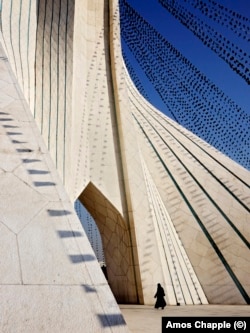
Ironically, the monument bearing the name freedom today bristles with cameras. "If they want to put a cable, mostly [for] security cameras for their own spying on people, they drive screws and bolts into the exposed concrete there, which has been poured with great attention," Amanat said.
The architect said the aesthetic of the Azadi Tower was drawn partially from exploring ancient Persian architecture, including the Vakil Mosque in Shiraz.
Gathering inspiration from his own country's heritage was relatively rare in the 1960s, when young Iranian creatives largely looked to the West for inspiration. The tower, Amanat says, "is somehow kind of giving an idea that it is connected to the very deep past, yes. But it is thinking of going forward because of its shape elevating to heaven."
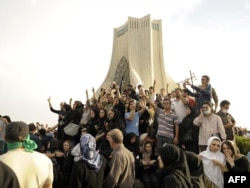
The Azadi Tower was one of the key gathering points for the 2009 protests that swept Iran following a disputed presidential election in June of that year.
Today, the same regime that prompted Amanat -- a member of the persecuted Baha'i faith -- to live in exile after the 1979 revolution still casts a shadow over his work. He is currently working on a shrine to the son of the founder of the religion in Acre, Israel. When Iran traded missile strikes with Israel in 2025, Amanat said foreign workers on the project, including Italian artisans, had to be evacuated, significantly delaying construction.
When asked what his first day in Iran would look like if he were able to return to the country of his birth, Amanat paused for thought before responding.
"I should pay my tributes or respect to the people who have been killed through all this period that I haven't been in Iran. People who have sacrificed themselves for the freedom of this country," he said.


