




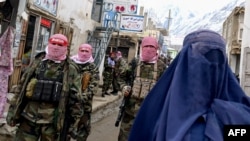
Fear has gripped Afghanistan's third city as the Taliban government violently enforces a stricter dress code for women.
Members of the Taliban's notorious morality police have arrested and even publicly beaten women in the western city of Herat accused of violating a new directive issued in early June.
The order prohibits women from appearing in public without what the hard-line Islamist group describes as a "proper hijab." Women who fail to comply, including those showing their faces or wearing makeup -- will face punitive measures, the directive said.
"Women in Herat were already wearing the hijab," a woman in the city told RFE/RL's Radio Azadi on condition of anonymity for fear of retribution, referring to the Islamic head scarf which covers the neck and head. "But now the Taliban demands that women wear a facemask, too, and cover their faces."
The Taliban's security forces arrested at least 30 women in the first week after the directive was issued, according to the United Nations.
The restrictions led to rare public protests in Herat on June 9 that were violently dispersed by Taliban forces. At least two people were killed and more than 20 wounded in the demonstration, the UN said.
Struck In The Head With A Rifle
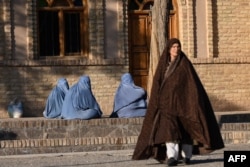
The Taliban's violent enforcement of the dress code has heightened apprehension among women in Herat. Some are too afraid to leave their homes, while those who venture outside risk the wrath of the extremist group.
Members of the Taliban's morality police routinely stop and inspect women in the streets, markets, and at the entrances to public buildings, several women told RFE/RL.
"Even those who are properly covered are sometimes stopped and questioned," a woman in Herat told RFE/RL's Radio Azadi.
Another woman in the city said the Taliban has clerics in local mosques to spread their messages.
"One order said female officers have been deployed to detain those who disobey," she said. "And it warned that if family members or others try to intervene, they will be arrested too."
The group has followed through on its threats.
In the Jadae Abresham area of Herat, the Taliban's morality police recently detained a woman on the street. When her relatives tried to step in, the officers detained them, too, an eyewitness told Radio Azadi.
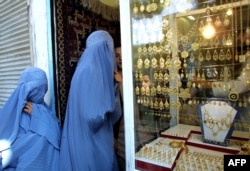
In Khwaja Kalla, another area of the city, the Taliban attempted to detain two young women even though they were wearing a hijab, an eyewitness said.
"When one of the women argued, officers struck her on the head with the butt of a rifle, causing bleeding. She was taken to a nearby hospital, but the morality police followed her inside and ordered doctors not to treat her," the eyewitness told RFE/RL. "The officers then took her away while she was still bleeding."
Locals say Herat, a city of some 1 million people located near the border with Iran, has gone quiet as more women stay at home.
"These are incredibly hard days for the women and girls in Herat," said another woman. "The city has fallen silent. Young women are too afraid to leave their homes."
Extreme Version Of Islam
Women have borne the brunt of the Taliban's attempts to impose their extreme version of Islam on the war-torn country of some 40 million people.
The group has largely erased women from public life and imposed severe restrictions on their appearance, freedom of movement, and right to work and study.
In 2024, the Taliban enacted a morality law that requires women to fully cover their faces and bodies when in public. The enforcement of the group's laws, however, has been sporadic and uneven across the country, and often left to the discretion of local Taliban leaders.
Many Afghan women wear a hijab. In addition, some women wear a face mask to conceal their nose and mouth. Other women don the burqa or an Islamic abaya robe and niqab that covers the hair, body, and most of the face. The latter is common in Arab countries in the Persian Gulf.
Afghan women, especially those in urban areas, consider the burqa and niqab to be alien to Afghan culture.
Before the Taliban's return to power in 2021, many women wore loose head scarves that only concealed their hair.