


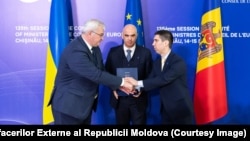
The European Union opened accession talks with Ukraine and Moldova on June 15 after the election of a new government in Hungary removed the final hurdle to moving the process of joining the 27-member bloc.
What follows may prove just as tough as the countries make the legal and policy changes necessary to become actual EU members.
What Does 'Opening Talks' Actually Mean?
The EU enlargement process consists of 33 policy chapters -- from foreign policy to agriculture and fisheries -- and the candidate countries must adopt all the EU laws and regulations in each of those chapters.
These chapters are divided into six clusters, and on June 15 Moldova and Ukraine opened up Cluster 1, known as "the fundamentals," which consist of five chapters dealing mainly with rule of law issues. These are always opened first and closed last, meaning a candidate country has fulfilled all of Brussels' conditions. Ukraine and Moldova have to date started talks on five out of the 33 policy chapters.
When Will They Start The Rest?
There are hopes in Brussels -- as well as in Kyiv and Chisinau -- that the other five clusters can be opened as soon as July, or at least by the end of the year. Either way, it would be record speed.
Albania, another EU hopeful, opened all six clusters in 11 months in 2024-2025. The European Commission says Chisinau and Kyiv are ready, having done the necessary groundwork in the two years since summer 2024, when Hungary started to yield its veto.
When Will They Be Set For Accession?
Ukraine has set the very ambitious target of closing all chapters by the end of 2027 and Moldova by 2028. This requires a lot of reforms on the sides of the candidate countries -- and political will by the 27 EU member states to go that fast.
According to the European Commission's progress report issued in November last year, Ukraine only had what was described as a "good level of preparation" in four policy chapters. For most other chapters there was just "some level of preparation." For Moldova, the number of chapters with "good level" preparation was just two.
It is simply harder to close than to open chapters. The EU is, for example, asking for complete overhaul in many areas, especially the judiciary. Just look at Albania, which since having opened chapters in November 2025 still hasn’t closed a single one. Or frontrunner Montenegro, which opened its first chapter back in 2013 and to date has closed 16 out of 33.
Do All EU Members Want To Fast-Track Enlargement?
This is dubious. Most say they want the club to enlarge but add that it should be merit-based, which is EU parlance for the fact that no shortcuts or fast-track memberships will be handed out.
In the past few months, numerous policy papers written by various EU countries have circulated in Brussels about how to speed up enlargement by, for example, offering "associate memberships" as an encouragement that would allow attendance in various EU institutions for some or all candidate countries but no voting rights.
The fact is, however, that the EU enlargement process always has been political. There are over 100 veto opportunities (opening and closing of every chapter plus interim benchmarks for many of them) for each of the 27 EU members that they can exercise for whatever reason.
North Macedonia has not advanced since 2022 due to a Bulgarian veto because Skopje still hasn't changed its constitution to reflect the role of Bulgarians in the country. Serbia has not advanced on its EU path since 2021 largely because several EU member states are concerned about its proximity to Moscow on foreign policy issues.
It is also worth remembering that even if all accession chapters are opened and closed, a potential lengthy ratification process in all EU member states will follow for each candidate country.
In Belgium, a ratification could require votes in 11 different regional and national chambers. There could even be referendums on the issue in places like Hungary and France, where there is considerable skepticism of EU enlargement, notably toward Ukraine.
The smart bet, for now, is that only Montenegro will join the EU by the end of this decade.