




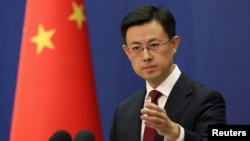
Beijing has placed seven companies in the European Union on an export control list, the Chinese Commerce Ministry said on April 24.
The firms, which operate in the defense, aerospace, and satellite intelligence industries, include the Belgian-based firearms manufacturer FN Herstal.
The announcement comes a day after the EU formally adopted its 20th sanctions package against Russia, targeting firms in third countries, including China, over Moscow's war in Ukraine.
These latest punitive measures from Brussels focus on tackling ways Russia seeks to circumvent existing sanctions, including through countries such as China and the United Arab Emirates.
As part of this round of sanctions, the EU has designated 16 entities in China, the United Arab Emirates, Uzbekistan, Kazakhstan, and Belarus that have "provided dual-use goods or weapons systems to the Russian military-industrial complex," according to the European Council.
Dual-use goods refer to items with both civilian and potential military applications.
The EU sanctions package will also place export restrictions on a further 60 entities that "contribute to the technological enhancement of Russia's defense sector," some of which are located in mainland China and Hong Kong.
Beijing's list of restricted entities includes two Belgian, one German, and four Czech companies.
The Commerce Ministry statement said that the sanctioned European entities will be barred from importing "dual-use" items from China in order to safeguard the country's "national security" interests, in accordance with its Export Control Law.
Speaking to Reuters on April 24, Czech military hardware supplier Excalibur Army, which appears on the list, stated that it does not "directly source any dual-use technologies from China and did not expect to see a material impact on its business."
According to a ministry spokesperson, the entities were targeted because of their participation "in arms sales to Taiwan" or "collusion" with Taiwanese authorities. Beijing considers the self-governing island to be part of its territory.
Responding to a question on April 23 about reports that Beijing had pressured three African countries to revoke flight permits for Taiwanese President Lai Ching-te, Chinese Foreign Ministry spokesman Guo Jiakun reiterated Beijing's position that the island nation was "an unalienable part of China's territory."
Taiwan is democratically governed and rejects Beijing's sovereignty claims.