




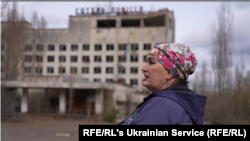
PRIPYAT, Ukraine -- Klavdia Omelchenko has never summoned the courage to return to her former home in the town of Pripyat -- hastily abandoned during the Chernobyl nuclear disaster in 1986 -- until now.
When she left, she thought it would be for a few days. But the 19-year-old had no idea that the biggest nuclear power plant disaster in history would change her life forever: destroying her health, killing her friends, and leaving her childless.
"I'm going to cry," she said, stepping through trees toward the crumbling gray housing block she once called home. She still recalls the address, but it was hard to find among the trees and bushes that have reclaimed the area since it was evacuated.


In 1986, Omelchenko was living a quiet life, working in a textile factory and planning to study in Kyiv. She was completely unaware when a routine safety test at Chernobyl, three kilometers down the road from Pripyat, spiraled out of control.
What Happened At Chernobyl?
One of the power station's four reactors overheated and then exploded, spewing radioactive fallout across the surrounding area and beyond.
The explosion occurred at 1:23 a.m. on April 26. But as the Soviet authorities raced to deal with the emergency, their response was marred by chaos, confusion, and secrecy. The residents of Pripyat were not told what had happened.
It was not until around noon the next day, April 27, that Omelchenko heard an announcement of an evacuation.
"They told us to take the necessary things for a couple of days. Everyone thought we were going to some kind of shelter. No one said anything specific," she recalled. "We saw that they were watering the sidewalks," she added, but nobody explained why.
Omelchenko said she left with a pair of jeans, a T-shirt, her identity documents, and a single bag.
"There were lines of buses by the buildings here," she said. "Yellow, like school buses. I waved and said: 'Goodbye little house, we'll be back soon.' And we left. We left forever. Remembering this, especially [standing] here, is tough. It's tough."
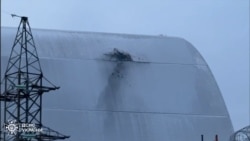
Some 115,000 people were evacuated from a 30-kilometer exclusion zone around Chernobyl that is still almost entirely uninhabited. Pripyat has since become an iconic location: a radioactive ghost town where nature has overgrown the streets.
A Final Homecoming
The buildings are now in such a state of disrepair that it would be dangerous to climb to the eighth floor, where Omelchenko once lived.
But taking shelter from a sudden storm, we ran into the entrance hall. Blue paintwork is peeling from the walls. Rusting mailboxes hang open.
"Box 32 is empty. Nobody has written to me," said Omelchenko with a sad laugh. She was often fighting back tears during the visit. After a moment of silence, she shouted: "My sister wrote this," pointing to graffiti on a broken door.
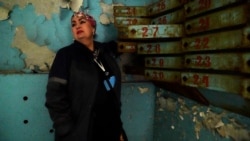
"We remember you, little house. The Bondarevs," it says. It must have been written when Omelchenko's sister and husband returned to visit Pripyat. She didn't feel able to come at that time.
After the disaster, Omelchenko was rehoused in Izmail, in southwest Ukraine. But her life would continue to be profoundly affected by what had happened.
"My friends died. One died pregnant. Back then, they forced pregnant women to have abortions, but she didn't listen. They buried her with the child, and she never gave birth," she said. "Another friend gave birth to a girl, who was mentally handicapped. And I was also left without children."
Omelchenko explained that her husband in Izmail refused to have children with her, because he was worried they would not be born healthy. "I don't want you to give birth to a mutant," he told her.
She had an abortion and the couple did not stay together, she said, bursting into tears at the memory. This would be both her first and last visit to Pripyat, she added.
Chernobyl: 'My Umbilical Cord'
After seven years in Izmail, Omelchenko managed to exchange her apartment for housing in Chernihiv, in northern Ukraine, and shortly afterward got a job at Chernobyl, where the station's remaining three reactors were kept in service until December 2000.
Decommissioning, decontamination, and other work to secure the site has been ongoing ever since, and Omelchenko is still employed in a staff canteen there.
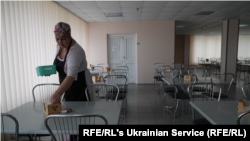
The Chernobyl disaster followed her in other ways. She said she has cancer and survives from operation to operation. But she did not want to dwell on the subject in detail.
The World Health Organization (WHO) says the disaster was followed by increased rates of thyroid cancer among those exposed to radiation who were children and adolescents at the time.
For now, Omelchenko said, she is trying to save up for a trip to Turkey for hair-restoration treatment. She said her biggest fear was losing her job. Her apartment, in Chernihiv, is empty.
"It's scary [even] to go on vacation, because you feel that nobody needs you anymore. But there's energy at work…among people," she said.
When Russia launched its full-scale invasion of Ukraine in 2022, Chernobyl and the surrounding areas were briefly occupied by Russian forces. Omelchenko chose not to flee.
"Chernobyl is dear to me," she said. "My umbilical cord is buried here. It pulls me back. It's even easier for me to breathe the air here."