





At 6 a.m. every day a message blasts through a Soviet-era loudspeaker and the lights switch on, jolting from their sleep 20-40 women in bunk beds in a cell at Prison Number 4 in Homel, southeastern Belarus.
It's one of two women's prisons in the country that may soon experience a reduction in inmates amid planned legislation for an amnesty with a special focus on women.
It's not yet known how many prisoners will benefit. Several thousand women are currently locked up, including 111 who are defined by exiled human rights group Vyasna as political prisoners.
In Homel, women convicted on political charges must sleep on the top bunk and must wear yellow tags to identify their status.
Two such women were human rights campaigner Nasta Loyka and civic activist Palina Sharenda-Panasyuk, who described daily life in jail to RFE/RL's Belarus Service. Both served time in Homel, while Sharenda-Panasyuk was also held in Zarechcha, some 100 kilometers to the west. It is a former military facility housing repeat offenders with 70-100 women in each room.
Vyasna figures currently classify 91 women in Homel as political prisoners, and just one in Zarechcha.
Sewing Uniforms
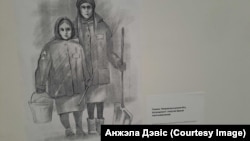
After being woken up, the inmates must get ready. Loyka said that in one section 100 women shared seven washbasins and four toilets.
"In 20 minutes, 100 people must make their bed in a special-shaped ‘envelope,' get dressed, take their pajamas to the locker room, go to the toilet, brush their teeth, and comb their hair," she said.
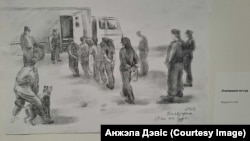
By 6.15-6.20 a.m., the women are lining up for a breakfast of porridge, white bread, and tea. Those who come last get about 10 minutes to eat. Work begins at 8 a.m., but before that the women must line up for inspection in the yard. Those with yellow tags stand in the front rows.

In Homel, this gives them a brief glimpse of the outside world as apartment blocks can be seen above several rings of prison fences.
"We see the windows of these homes. When it's New Year's Day, a holiday, people hang up a lot of garlands, hearts, stars. We see something so beautiful," Loyka said.
There are then random searches before they enter the factory.
"When you unbutton your jacket, they check your pockets and grope you completely," Loyka said.

Most women work at a garment factory. Women cut, sew, and iron uniforms. A place in the cutting shop is one of the most highly paid jobs, earning more than 100 rubles a month (roughly $30). For women who are forbidden to transfer money from home, such as those on the official "terrorist list," this is a relief.
Around 3 p.m., the first shift leaves the shops and the second shifts come in. Lunch is at noon and lasts about an hour.
At Zarechcha, the work is similar, but here the women sew uniforms for the Russian Army and Belarusian security forces. Sharenda-Panasyuk said that in her experience other convicts treated political prisoners better at Zarechcha, warning them of snitches and trying not to provoke them.
"Psychologically, it was easier to be there," she said.

Sharenda-Panasyuk recalled that in Zarechcha prisoners were fed cold meat three times. When asked whether that meant three times a week or a month, she answered, "Three times a year." Sometimes the women sorted through rotten onions, carrots, beets, and cabbage to seek vitamins not on the prison diet.
"They would just take this beet or carrot; it's all in the ground. They'd wipe it on the stove, which is almost never washed, and scrape something off. And then they eat these dirty vegetables. They peel the onion and eat it, too," she said.
After work, inmates have some free time to read or write letters. In Homel, it's compulsory to watch "educational broadcasts" on state TV. At 4 p.m., the second of the day's inspections takes place and at 8 p.m. a third, exclusively for those with yellow tags.
There's also a library, a gym, a church, and a club where events and concerts are held. But often these are inaccessible to political prisoners.
On Sundays, the women are allowed to shower. Each gets 15 minutes.
"The day we go to wash is automatically a little more pleasant," said Loyka. Other high points include a weekly shopping day and calls to relatives three times a month. Long meetings with loved ones (from one to three days) are allowed three times a year.
Punishments
However, any of these privileges can be revoked for violations. Those deemed to be breaking prison rules can also be sent to a punishment cell: a cold, concrete room.
Violations can include such trivial actions as hugging someone, borrowing toilet paper, leaving the top button of their dress undone, or talking during an inspection.
Loyka said the objectification and abuse of women by male guards was also an issue. Sometimes, the men would watch the inmates on surveillance cameras.
"When we'd come back in the evening, the women would change. One employee would not only watch (on a monitor), he would also comment if someone had holes in her underwear.... Some male employees would come in (on the pretense of) checking the sinks or even the toilets," she said.
Loyka added that one officer repeatedly said the inmates' mandatory breast badges were crooked and would rip them off their uniforms.
Sharenda-Panasyuk described harsh work conditions in Zarechcha that included being harnessed to a cart like a horse and pulling heavy loads. She said political prisoners were put under extra pressure by being housed in units with mentally ill inmates who could turn violent.
At 9.30 p.m., inmates can go to bed. At 10 p.m., workers from the second shift return to their cells. Sharenda-Panasyuk described a frantic rush to be first to arrive back, get access to a washbasin, and have time to drink tea.
"It looks a little comical, but behind this comedy lies a great human tragedy," she said.
Once everyone is in bed, there is neither total darkness nor any sense of calm: Prison guards roam the rooms throughout the night, shining their flashlights.