




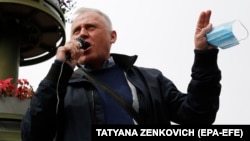
At around 1 p.m. on a cloudy day in September last year, a bus containing Belarusian political prisoners approached the Lithuanian border.
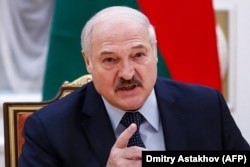
Belarus's longstanding authoritarian leader Aleksandr Lukashenko -- who presided over a deadly response to massive protests that erupted after he was declared the victor of a 2020 presidential election -- which many citizens say was stolen -- had agreed to release the prisoners in exchange for US sanctions relief, on condition that all would head into exile.
But one of them, Mikalay Statkevich, had other plans.
“I saw that there was a jostling near the door, then the door opened and he got out,” Yauhen Afnahel, one of the prisoners on the bus, told RFE/RL’s Belarus Service in a new podcast series which contains previously undisclosed details of a series of prisoner releases negotiated by US special envoy John Coale that have seen some 500 people freed.
Coale was expected in Minsk again on September 14, reportedly to seek another prisoner release. On that cloudy day last year, the US diplomat was waiting just down the road for 52 people whose freedom he had secured. Then only 51 arrived.
Shortly after, CCTV images revealed Statkevich sitting in the border zone between the two countries, with the Lithuanian checkpoint and it’s European Union emblem tantalizingly nearby.
Statkevich, then 69, has spent decades fighting against Lukashenko, who has ruled Belarus with an iron grip since 1994.

He has been imprisoned repeatedly and was serving a 14-year sentence on various political charges, such as participating in an unauthorized demonstration, when Coale negotiated his release.
Former political prisoner Syarhey Sparysh, who was also on the bus with Statkevich, said that he realized while they were being held at a KGB detention center in Belarus earlier that day that Statkevich would not leave.
“I saw his facial expression. It was the look of a berserker, a look of resolve. He had such a smile and a jaunty stride,” he told RFE/RL.
That resolve would withstand efforts by close friends and associates to persuade him to change his mind and walk across the border.
One such was Belarusian opposition figure Yauhen Vilski, who said American diplomats and Statkevich’s wife also tried to convince him to join the others.
“Mikalay Viktaravich told me that he was sorry, but he’d decided to stay in Belarus and that Lukashenko was not going to tell him where he should be,” Vilski said.
'Great Inner Strength'
Journalist Aksana Kolb, in a telephone conversation with Statkevich, also tried to convince him to leave.
"In the end, he just said, 'Let me breathe this air, let me look at the sky, at everything. Don't pressure me, don't blackmail me,'" she told RFE/RL.
After that, masked security officers took Statkevich back to Belarusian territory.
“What he did shows that he has a great inner strength that allows him to carry such a heavy burden," said Belarusian Nobel Peace Prize winner Ales Byalyatski.

Back in Belarus, Statkevich found himself back in the same prison that he had just been released from, Hlybokaye in eastern Belarus. This was not communicated to his wife, Maryna Adamovich, even when she came to search for him there nearly a week later.
The day she visited the prison, September 17, Lukashenko confirmed that Statkevich had been arrested but said nothing of his whereabouts. Maryna Adamovich would only find out where he was several months later.
'A Moral Leader'
In February this year, Statkevich was released after suffering a stroke the previous month. He was in a wheelchair and had difficulty speaking.
He’s now at home in Minsk, where he has started a Telegram channel. He writes about Russia’s war on Ukraine and Russian nuclear threats. In March, he also called on European countries to finance a volunteer army of young, exiled Belarusians to protect Ukraine from Russia launching an attack from Belarusian territory -- as it did in 2022.
For this, the authorities can throw Statkevich behind bars again at any moment.
His case highlights how, despite releasing hundreds of prisoners, the Lukashenko regime has not changed its repressive nature. Exiled Belarusian human rights group Vyasna has reported how Belarus has continued detaining people on political charges since the series of releases negotiated by Coale began.

Its latest report counted 880 political prisoners who were subject to “torture and other forms of cruel, inhuman, and degrading treatment.” It said at least 60 had serious health problems.
The new podcast series, The Belag Archipelago: Season 2, documented several cases of people dying in prison amid unclear circumstances.
For the regime, these people are useful bargaining chips to negotiate sanctions relief from Washington.
“It resembles negotiations with terrorists when hostages are involved. In fact, our political prisoners are in a similar position,” Byalyatski told RFE/RL.
Statkevich’s defiance challenged Lukashenko’s strategy.
“He absolutely understood that he would do everything he could to remain in the country. Because someone had to remain in Belarus as a moral leader, a protest leader, a national leader,” said Sparysh.
“He could, just by being present in Belarus and present in the Gulag, uphold the banner of struggle," he added.