




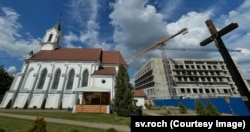
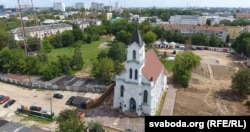
Paval Khadzinski has been going to the Church of St. Roch for as long as he can remember, and an ancestor who lived in the 19th century was buried at the Catholic cemetery next to the sanctuary in a central Minsk neighborhood called Zalataya Horka, or Golden Hill.
Khadzinski, 41, remembers a time when a playground opened near the church and parishioners hoped a garden would be next: a pleasant green space in the middle of the city. Now, there's a construction site covering a large part of the cemetery, which remained intact despite portions being developed or destroyed during the Soviet era.
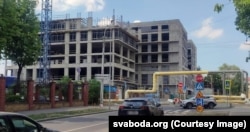
The government of authoritarian leader Aleksandr Lukashenko has been highly secretive about the site; by the summer of 2025, a massive construction pit was visible in satellite images, and a building frame was standing by February 2026. In some official documents, it is tersely identified as a "multifunctional building," and in others it doesn't exist.
By obtaining design documentation and speaking with several people connected to the project, RFE/RL's Belarus Service has learned that the state has chosen the site for a sprawling National Security Academy complex for the KGB -- as the oppressive main security agency is still known -- on the grounds of the former Zalataya Horka cemetery.
Moreover, RFE/RL has found that the project is being built based on a decree apparently issued in secret by Lukashenko, allowing builders to bypass an array of legal protections that remain on the books and are designed to preserve such sites.
The construction comes as pressure on the Catholic Church persists despite signs of warming in long-tense ties between predominantly Catholic Poland and mostly Orthodox Christian Belarus: Since the start of this year, at least 20 Polish Catholic priests have been banned from serving or forced to leave the country.
Many Polish priests came to Belarus to help rebuild Catholic parish life after decades of Soviet repression, and some have served local communities for decades.
"We have a presidential decree," Yuliya Serada, the development project's chief engineer, said when asked what enabled it to go ahead despite the protective legislation.
Responding to further questions, Sereda said there had been no change in the protected status of the site, suggesting the decree allowed exemptions for this project. She said the engineers had not planned the archaeological works that are normally required and did know how excavated soil was being handled during construction.
'It's Just Wrong'
Independent architects and government opponents said the project put the state's selective attitude toward the rule of law on display in Belarus, where Lukashenko has persistently clamped down on basic freedoms and used fraud-marred votes to extend his rule over the nation of roughly 9 million since he was first elected in 1994.
"They didn't even try to pretend they were implementing the law," a Belarusian architect and restorer who works in heritage protection said, speaking on condition of anonymity for security reasons.
"Most likely, they immediately went to Lukashenko and said: 'We want to build here, but the law prevents it.' And he says: 'No problem, here's your order, go ahead, go build,'" he told RFE/RL.
A law adopted in 2001 prohibits capital construction, with the exception of memorial and religious projects, on the site of old burials. The site's protection-zone plan, approved by the Culture Ministry in 2018, also prohibits the installation of utility networks on the former cemetery grounds.
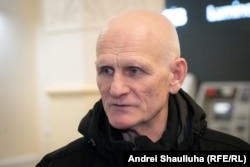
"A cemetery is a cemetery. No one was going to build anything there," veteran Belarusian human rights activist and 2022 Nobel Peace Prize laureate Ales Byalyatski told RFE/RL.
Byalyatski, who spent years in prison before his release under a US-Belarus agreement last December, recalls from his time on the Minsk city council's culture committee in the 1990s that the former cemetery was considered off-limits for development despite being a prime piece of land in a central location.
Building a KGB training center on the site "seems very cynical," he said, pointing to the Soviet security services' persecution of the Catholic Church and the continuing pressure on it today. "It's just wrong."
The dominant Belarusian Orthodox Church is affiliated with the Moscow-based Russian Orthodox Church and closely tied to the state.
Issues concerning historical and cultural heritage sites in Belarus are among those considered by the Republican Council for Historical Policy, which is attached to Lukashenko's administration.
'A Great Joy'
The first deputy head of the National Security Academy, Henadz Krasko, is a member of the council. Krasko did not respond to phone calls seeking comment, and the National Security Academy could not be reached for comment.
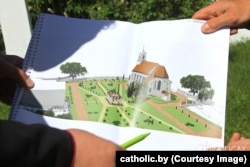
In the summer of 2018, a small park with a children's playground opened adjacent to the church, with priests and parishioners involved in creating the space and keeping it tidy.
That October, the former cemetery was included in a protection zone, approved by the Culture Ministry, where construction and the laying of underground infrastructure were prohibited.
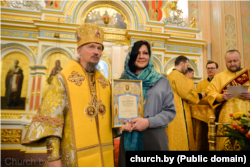
"This is a guarantee that the area…will not be built up. It has come under state protection," St. Roch priest Yury Sanko told Vatican News in 2019. "It is a great joy that the Zalataya Horka cemetery, which was not completely destroyed during the Soviet era, will be preserved."
Not for long.
The state investment program for 2024, approved by Lukashenko, included a clause allocating money for design and survey work for "the construction of a multifunctional building at 5 and 5a Zalataya Horka Street in Minsk" -- a substantial part of the former cemetery grounds.
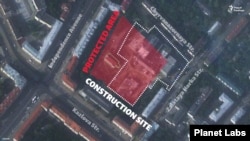
The program said nothing about the purpose of the building, and the government has not disclosed it publicly to this day.
In February-March of this year, the district administration held public discussion of changes to the development plan for the Golden Hill area. But the documentation shown to residents provided for a small square on the territory of the former cemetery; there was not a word about the complex that had already been under construction for months.
Weapons Storage
BelPol, an association of former Belarusian security services officers, reported in 2023 that a new National Security Academy building could be constructed on the cemetery site, with a dormitory designed to house 150 students.
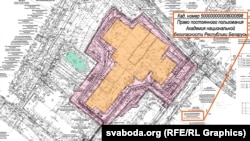
The planning documentation obtained by RFE/RL shows that the site has been allocated to the National Security Academy, which is subordinate to the KGB.
In a detailed blueprint, the academy building dwarfs the adjacent church, and the footprint of the new structure is made even larger by a surrounding area designated for pipes, power lines, and other infrastructure.
Documents describe a large structure with three sections totaling about 36,000 square meters. One of them, a six-story "academic building with a dormitory," is designed for 1,250 students and has beds for 627.

The underground level of this section, labeled Block A, is designed to house a shooting gallery with an area of nearly 600 square meters as well as separate warehouses for storage of weapons; radiation, chemical and biological protection equipment; and other military-style supplies.
A separate wing is reserved for the institution's management. Documents describe two suites, each of which total roughly 100 square meters and includes a "manager's office," a reception area, a relaxation room, and a bathroom with a shower.
Block B includes a canteen, with three dining halls for a total of 340 people, as well as a sports complex with running tracks and courts on the roof for mini-football, basketball, volleyball, badminton, and tennis. Block C is designed to house a gym, a 25-meter swimming pool, locker rooms, showers, and two saunas.
'Shameful'
Officials contacted by phone did not comment on the purpose of the building going up on the site or on how any human remains discovered during excavations may have been handled. Natalya Balotnikava, a senior urban planning official in the Minsk city administration, said information about the facility was "restricted."
Former Culture Minister Ruslan Charnyetski, who held the post when a contract for the development of design documentation for the project was signed in December 2024, declined to comment.
Since 2021, when it was designated an "extremist formation" by the Belarusian government, RFE/RL's Belarus Service has received no official answers to questions addressed to the authorities.
In calls to officials for this report, the correspondent identified themself as a local resident. In a conversation with Charnetski, the correspondent identified themselves as a law student.
The Catholic cemetery was closed to burials in about 1920. Khadzinski, the parishioner, said that at a time when gravestones still stood near the church, he photographed one that he later understood was that of 19th-century priest who was his ancestor.
"When Christian cemeteries are destroyed, it is an insult to both the dead and the living," Khadzinski said, adding the parish should be told of the fate of human remains on the construction site, and the memory of those buried there should be honored.
"There should be a clear memorial, and there should be a Christian reburial of those people who were found beneath the excavator buckets," he said. "That's why this looks very shameful and unacceptable."