





YEREVAN -- The ruling Civil Contract party of Prime Minister Nikol Pashinian has taken a big lead in a crucial parliamentary election, gaining 51.4 percent of the vote as initial ballots are counted.
The Central Electoral Commission (CEC) early on June 8 said that with nearly 26 percent of ballots counted, the pro-Russia Strong Armenia alliance was in second at 23.3 percent. The Armenia Alliance, led by former President Robert Kocharian and also considered to be pro-Moscow, was in third at 9.6 percent.
Pre-vote polls had indicated Civil Contract had 24-32 percent support, while Strong Armenia was at 9-11 percent.
Election officials reported strong turnout as Armenians voted in a test of the prime minister’s support following a controversial peace deal with neighboring Azerbaijan and his efforts to pull the small South Caucasus nation closer to the West after decades of reliance on Russia.
"We will accept any choice made by the people," Pashinian told reporters after casting his ballot at a polling station in the capital, Yerevan.
Pashinian said Armenia would pursue a balanced foreign policy after the election, adding that "there is no question of choosing" between Russia and the West.
The CEC said nearly 59 percent of the country’s 2.5 million eligible voters had cast their ballots by the close of voting at 8 p.m. local time.
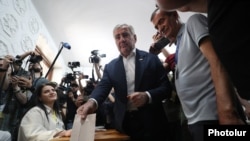
Voters were choosing from 18 political groupings at 2,005 polling stations across the country with Pashinian’s Civil Contract party holding the lead in pre-vote polls over a number of pro-Russia parties.
Some 400 international observers were authorized to monitor the vote. The CEC said preliminary results will be released within 24 hours of polls closing and final results are to be announced on June 14.
Yerevan's ties with Moscow have emerged as a major electoral issue, especially following Russia's decision to impose restrictions on Armenian exports in recent weeks in response to its further drift to the West.

On the eve of the elections, Armenian authorities arrested six Strong Armenia candidates, state media reported, without providing a reason.
Strong Armenia has said it seeks to maintain Yerevan's economic and political ties to Russia and has accused Pashinian of dangerous hostility toward Moscow.
Strong Armenia is led by Russian-Armenian billionaire Samvel Karapetian, who is under house arrest on charges of calling for the overthrow of the government. He has labeled the accusations politically motivated.
Allegations Of Irregularities
Election authorities and independent observers reported a range of alleged irregularities during voting on June 7, according to information gathered by RFE/RL local correspondents.
By the end of voting, Armenia's Anti-Corruption Committee reported that 33 criminal proceedings had been initiated in connection with alleged electoral crimes.

The country's Interior Ministry earlier reported that it had launched investigations into alleged cases of double voting and violations of ballot secrecy.
The monitoring group Independent Observer reported disruptions and procedural issues at several polling stations. According to the group, monitors were present at 1,420 polling stations nationwide, with alleged violations recorded at hundreds of them.
US, EU Support For Pashinian Party
The US and EU have exhibited support for Pashinian, who assumed power in 2018 following a mostly peaceful popular uprising -- known as a Velvet Revolution --against the previous Moscow-friendly government.
Pashinian has begun the process -- albeit one expected to take many years -- of joining the EU and pressed forward in the peace process with neighboring Azerbaijan, a controversial policy that has bolstered the opposition and angered even some of his former supporters.
Pashinian won heavy US backing after agreeing to participate in US President Donald Trump's Route for International Peace and Prosperity (TRIPP), completing the bilateral signing process after Secretary of State Marco Rubio signed the document after it was initialed during a visit to Yerevan last month.
The US State Department told RFE/RL it sees the initiative as "a crucial and enduring part of bringing peace and prosperity to Armenia and the South Caucasus."
The prime minister has also attempted to normalize relations with longtime bitter rival and neighbor Turkey, a close ally of Azerbaijan.
His government has frozen participation in the Russian-led Collective Security Treaty Organization (CSTO).
Yerevan Hosts EU, Zelenskyy
Pashinian's goal of eventual EU membership, his eschewing the CSTO, and the decision to host EU-related summits in Yerevan -- one that included Ukrainian President Volodymyr Zelenskyy -- angering Moscow and have led to threats of ending preferred economic rights for Armenia.

Russia has long considered Armenia part of its sphere of influence. Russian President Vladimir Putin has made a thinly veiled threat about Yerevan's westward aspirations, saying Armenia could face a "Ukrainian scenario" due to its European integration aims.
The parliamentary elections represent a "historic moment" for the country, Ulrich Schmid, professor of Eastern European Studies at the University of St. Gallen in Switzerland, told France 24 TV.
Pashinian "has pressed forward toward a normalization of relations with both Turkey and Azerbaijan," he said. "Armenia's foreign policy is traditionally caught between two traps -- the Turkish trap and the Azerbaijan trap."
The prime minister "is ready to push toward what we call 'realistic Armenia,'" exchanging traditional fears and resentment for more pragmatic policies, he said.

