




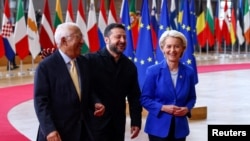
The European Commission is putting forward a new 45-billion-euro (nearly $50 billion) loan proposal for Ukraine on November 18, to cover a large part of the financial shortfall the war-torn country is facing for 2027.
But the plan risks being tangled up in a separate though related discussion among European Union capitals on the next multiyear EU budget (2028-2034) that leaders hope to decide on before the end of the year.

What's The Plan?
The new proposal is meant to cover about two-thirds of the 70-billion-euro ($77 billion) budget shortfall that Ukraine has announced for next year with hopes in Brussels that other Western allies of Ukraine such as Canada, Japan, Norway, and the United Kingdom could cover the rest.
"We think this is the best way to give Ukraine a strong hand at the negotiating table," European Commission President Ursula von der Leyen said, referring to ongoing diplomatic efforts to bring an end or pause to Russia's war on Ukraine.
According to the proposal, seen by RFE/RL, the commission recognizes that the Ukrainian budget gap has occurred due to Russia’s ongoing attacks and notes that “swift financial assistance is vital to help Ukraine maintain essential state functions, ensure macroeconomic stability, rehabilitate critical energy infrastructures, and invest into its defense, technological, and industrial basis.”

It also cautions that “Ukraine’s economy is already vulnerable due to damage to key infrastructure, labor shortages, and the ongoing displacement and mobilization of people. It is further at risk of additional negative shocks due to increasing attacks that may lead to increased expenditure needs and reduced tax revenues.”
Of the 45 billion, 25 billion ($27.4 billion) is expected to go to Kyiv’s defense sector, 10 billion ($11 billion) for the national budget, and another 10 billion for so-called “macro-financial assistance” to stabilize Ukraine's foreign currency reserves.
Russian Reparations
The loan, which the European Commission states will be “repaid by reparations due by Russia," functions in the same way as a previous EU loan of 90 billion euro ($99 billion) agreed in December 2025 that the EU at the time hoped would cover most of Ukraine’s financing needs for 2026 and 2027.
Back then European leaders opted for a loan backed by the EU budget “headroom,” meaning the gap between the bloc's maximum borrowing capacity under its long-term budget and its actual spending levels.
This was agreed instead of using a much-publicized "reparation loan" by leveraging Russian state assets currently frozen inside the bloc as collateral. Belgium vetoed that initiative as most of the assets sit in the Brussels-based financial markets company Euroclear.

Many EU member states have pushed for the European Union to revisit the idea of using the frozen assets but several diplomats with knowledge of the situation who cannot speak on the record told RFE/RL that Belgium hasn’t budged on the issue and that other countries such as Luxembourg and France are also quietly supporting Belgium on this.
Back then, three EU countries -- the Czech Republic, Slovakia, and Hungary -- had obtained an opt-out from the interest costs connected to the €90-billion loan even though they still needed to give the political green light.
For the new loan, Bulgaria has already indicated that it will join those three.
The EU Budget Row
As all four are net recipients of the long-term EU budget, their stance recently prompted German Chancellor Friedrich Merz to threaten to halt negotiations on the bloc’s 2028-2034 budget unless all EU members contribute financially to Ukraine.
Germany is currently both Europe’s biggest bilateral donor to Kyiv and the largest net payer into the EU budget, which mainly relies on national contributions based on member states’ Gross National Income (GNI).
EU leaders are due to debate the proposed 1.8 trillion-euro ($1.97 trillion) EU budget at a summit in Brussels on November 26-27 with a view to coming to a final agreement when they assemble again on December 17-18.
But Merz’s gambit to tie Ukraine funding to the larger question of the entire EU budget has now thrown everything into jeopardy.
Most diplomats in Brussels would prefer to have all issues agreed by the end of 2026 as many fear that a year of elections in Europe in 2027 might upend any spending decision.
There is particular concern that all elements of the deal must be agreed before France's presidential election in April and May next year, with polls suggesting the far-right leader Marine Le Pen looks poised to replace Emmanuel Macron in the Elysee Palace.
On the campaign trail, Le Pen has pledged that she would be in favor of ending financial support for Ukraine if she wins.