




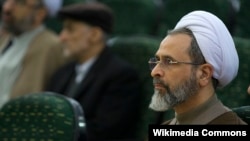
A senior Iranian cleric who briefly helped exercise the powers of Iran's supreme leader following the death of Ayatollah Ali Khamenei has visited Sarajevo, urging European countries to distance themselves from US and Israeli policies toward Tehran.
Ayatollah Alireza Arafi told Bosnian media outlet Klix.ba that Iran "recognizes no red lines when it comes to self-defense" and expressed a desire to deepen relations with Bosnia in culture, education, and the arts.
Arafi attended the November 15 inauguration of Nedzad Grabus as Grand Mufti, or reis-ul-ulema, of the Islamic Community in Bosnia and Herzegovina.
But the visit may have significance beyond religious diplomacy.
Arafi is the highest-ranking Iranian official known to have traveled to Europe since the war with the United States and Israel began in February. His visit followed talk among political figures in Iran of expanding the conflict to include European countries that host US military bases.
"I think Iran will use this opportunity to strengthen ties with the authorities of Bosnia and Herzegovina and attempt to make use of their influence in managing tensions between Iran and Europe," said Ali Afshari, an Iranian political analyst based in Washington.
A Powerful Figure In Iran
Arafi, 67, is one of the most influential figures in Iran's religious establishment and was a close ally of Khamenei.
Following Khamenei's death in joint US-Israeli strikes on February 28, Arafi became one of three members of an Interim Leadership Council, alongside President Masud Pezeshkian and judiciary chief Gholam Hossein Mohseni Ejei.
The council temporarily assumed the supreme leader's powers. Its mandate ended little more than a week later, when Khamenei's son Mojtaba was chosen as Iran's new supreme leader.
Arafi has also served on the Guardian Council, which vets election candidates and reviews legislation, and as deputy chairman of the Assembly of Experts, the body responsible for selecting the supreme leader.


From 2008 to 2018, Arafi headed Al-Mustafa International University in Qom, an institution that trains foreign Shi'ite clerics and religious scholars and claims to have branches in more than 50 countries.
In December 2020, the United States sanctioned the university, accusing it of facilitating recruitment by the Quds Force, the foreign operations arm of Iran's Islamic Revolutionary Guards Corps (IRGC).
The US Treasury said the Quds Force used the university's international network to recruit intelligence sources and foreign fighters for militias supporting then-Syrian President Bashar al-Assad.
These included the Fatemiyoun Division, composed primarily of Afghan Shi'a, and the Zaynabiyoun Brigade, made up of Pakistani Shi'a. Several university students were killed fighting in Syria, according to the Treasury.
Arafi headed Al-Mustafa during much of the Syrian civil war, although the US sanctions announcement did not accuse him personally of directing recruitment.
Longstanding Ties With Bosnia
The Islamic Community in Bosnia, whose members traditionally adhere to Sunni Islam, has maintained contacts with Iranian Shi'ite institutions for years.
Former Bosnian Ambassador to Iran Emir Hadzikadunic said Arafi had longstanding ties with the community through visits and cooperation in religious education.
"I think this is purely a ceremonial matter. He is an appropriate figure for this type of cooperation," Hadzikadunic told RFE/RL.
In June 2015, then-Grand Mufti Husein Kavazovic led a Bosnian delegation to Iran and met Arafi at Al-Mustafa University.

Kavazovic emphasized the religious traditions of Bosnian Muslims and warned about foreign groups presenting themselves as representatives of Shi'a, prompting concern among local religious scholars.
Contacts continued, including meetings with Iranian religious and diplomatic officials.
Following US and Israeli attacks on Iran this year, the Islamic Community called for an end to the war and a return to diplomacy. In April, however, it announced it would not organize memorial prayers marking the 40th day after Khamenei's death.
It is not publicly known whether Arafi met other religious or political officials during his November visit.
Afshari said he believes Bosnia could serve as a bridge between Tehran and Europe, although he cautions that the ideological outlook of Iran's leadership does not necessarily align with the views of Bosnian Muslims.
"Nevertheless, Bosnia and Herzegovina is one of the most important countries for Iran when it comes to maintaining ties with Europe," he said.