




US President Donald Trump has walked back his plan to charge a 20 percent fee on cargo shipped through the Strait of Hormuz, replacing it with proposed trade and investment agreements with Persian Gulf states while maintaining a blockade on Iranian shipping.
“Based on highly productive conversations with Middle East leadership, I have decided to replace the 20% United States Reimbursement Fee with Trade and Investment Deals that the various Gulf States will be making into the United States,” Trump wrote on Truth Social.
He provided no details of any commitments by Gulf governments but said the investments would be “MASSIVE.”
The policy shift came as US forces continued striking targets across southern Iran and enforcing the renewed blockade.
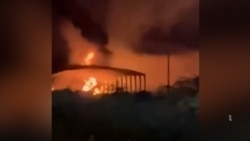
Explosions rocked parts of Iran through the day on July 14 as the US military hit targets inside the country, while Tehran launched missiles around the Persian Gulf.
Iranian state media reported that five explosions were heard around the port city of Bandar Abbas, near the Strait of Hormuz, which has been at the center of renewed fighting between the United States and Iran. The port city of Bushehr, home to Iran's sole nuclear power plant, also came under attack.
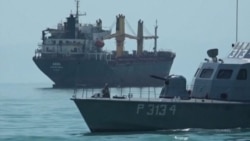

Blasts were also reported on several islands off of Iran's southern coast, including Kish, Qeshm, and Abu Musa.
Jordan and Bahrain said they had intercepted barrages of Iranian ballistic missiles and the United Arab Emirates reported attacks on vessels in the strait that left one crew member dead and at least eight others wounded.
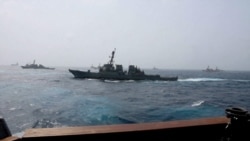
US Central Command (CENTCOM) said a naval blockade against maritime traffic entering and exiting Iranian ports would be reinstated from 4 p.m. Eastern Time on July 14.
"CENTCOM forces will enforce the blockade against vessels transiting to or from Iranian ports and coastal areas. The U.S. military continues to support traffic flow through regional waters for all vessels not violating the blockade," CENTCOM said in a statement.
The strikes are the latest sign of the unraveling of an accord signed last month setting out conditions under which the two sides would negotiate a peace deal.
Over the weekend, Trump notified Congress that the United States was once again at war with Iran, starting a 60-day period during which he could order military strikes without having to seek formal approval from lawmakers.
Speaking to reporters at the White House late on July 13, Trump said the attacks were aimed at disabling Iran's ability to disrupt maritime traffic in the strait.
He added that despite the renewal of attacks on Iran, a deal to end the fighting is still possible.

"Yeah, I think a deal is possible. Sure, I do," Trump told reporters in the Oval Office. "We had a deal with them two days ago and then they said 'Oh we can't make that deal. We have to negotiate it further.'"
Earlier on July 13, Trump told Fox News that the United States may take control of the strait, which during peacetime handles about one-fifth of the world's energy transit and has become one of the main battlegrounds of the conflict.
Later that day, Trump declared in a social media post that the United States was “THE GUARDIAN OF THE HORMUZ STRAIT” and proposed charging a 20 percent fee on cargo shipped through the waterway before abandoning the plan a day later.
Iran's Islamic Revolutionary Guards Corps (IRGC) had said in a statement just before Trump's announcement that the only way to restore regular shipping traffic through the strait was to end US military intervention in the waterway.
Iran's top joint military command later said the US had no role in determining the future of the strait, warning countries cooperating with Washington "bear full responsibility for all insecurity and the escalation of the war in the region."
Iranian Foreign Minister Abbas Araqchi also reacted to Trump's social media post, saying that "Iran has always been the GUARDIAN of the Strait and will remain so FOREVER."
The military escalation has raised fresh questions about the fate of the agreement that had offered hopes of a negotiated settlement.
Trump said last week the Memorandum of Understanding was void in his mind, though he added that negotiators could continue to hold talks if they felt progress could be made on a peace accord. But a weekend of attacks has dimmed those prospects even further.
Iranian Foreign Minister Abbas Araqchi met Omani Foreign Minister Sayyid Badr Albusaidi over the weekend to discuss mechanisms for ensuring safe navigation through the Strait of Hormuz, according to Tehran.
Earlier, Oman said discussions with Iran would continue at both the technical and political levels in an effort to reach agreements consistent with international law regarding navigation through the waterway.
No US officials took part in the discussions.

RFE/RL learned from diplomatic sources that Omani mediators handed proposals to the Iranian delegation aimed at resolving disputes over maritime navigation. Senior officials declined to comment on the substance of the proposals.
According to diplomatic sources familiar with the discussions, Iran left the negotiations saying it would return after reaching a unified internal position on proposals that would have allowed freedom of navigation through Omani waters in the southern part of the strait without tolls.
Shortly afterward, Iran's national security apparatus responded by firing on a commercial vessel and announcing the closure of the waterway.
In recent months, Trump has promoted what he has called the "Southern Highway" -- a shipping route that keeps vessels closer to Oman's coastline and farther from Iranian territorial waters.
Tehran has repeatedly insisted that only its preferred route, running closer to the Iranian coast, is considered safe and has previously been accused of targeting vessels using the Omani route.
War Of Words Raises Risks
The latest confrontation unfolded against an increasingly volatile political backdrop.
Iran's new Supreme Leader Mojtaba Khamenei vowed revenge for the killing of his father and predecessor, Ali Khamenei, saying retaliation "must inevitably be carried out."
Ali Khameini, who was killed in US and Israel air strikes on February 28 as the war broke out, was buried on July 9 at the Imam Reza shrine in Mashhad.
"This matter depends neither on my personal existence nor on that of other officials. Whether we are present or not, it will come to pass," he said, adding that Iran had compiled a list of individuals to be targeted.
Hours earlier, Trump warned that any assassination attempt against him would trigger overwhelming US military retaliation.

